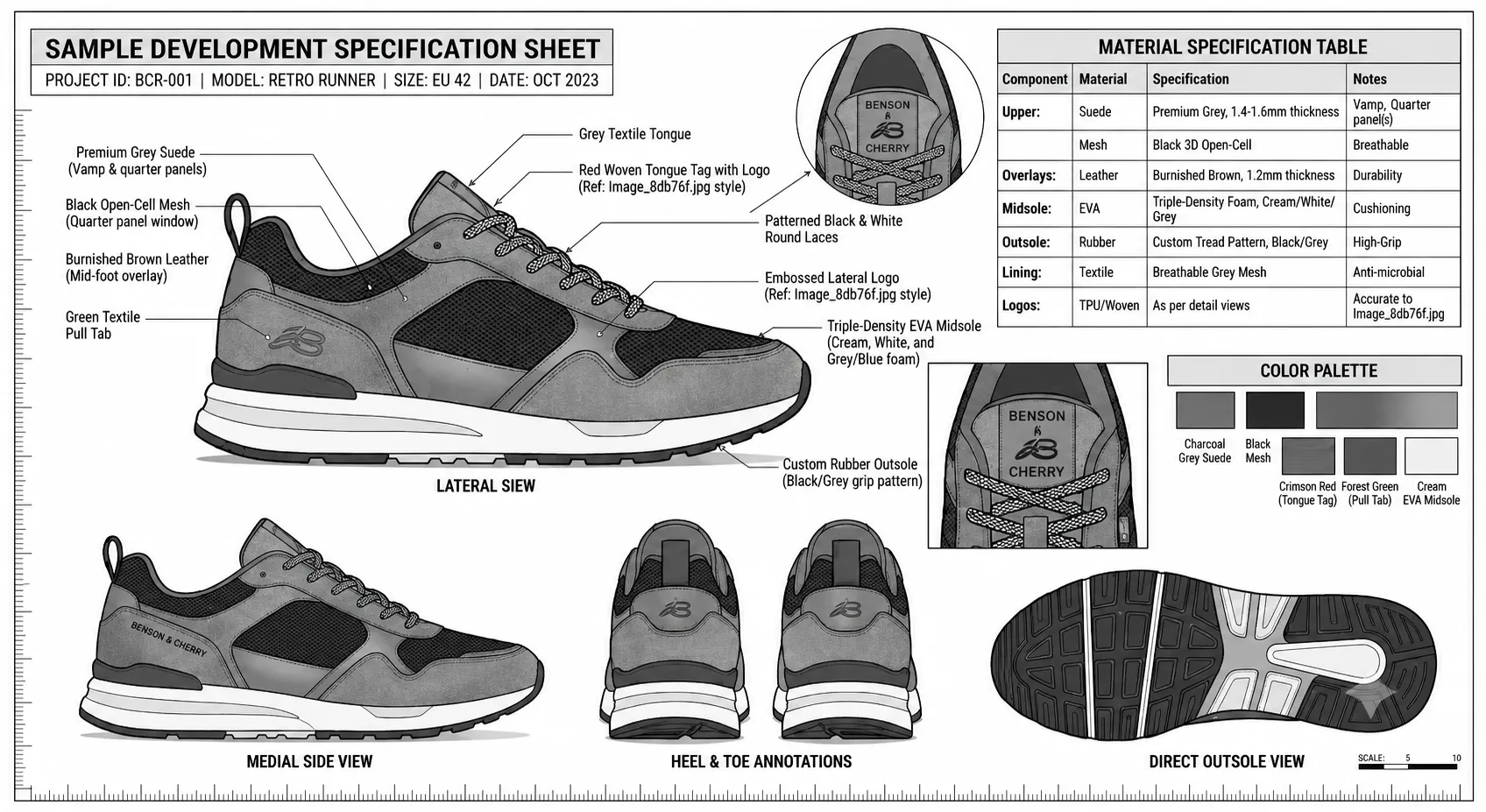

A shoe outsole is the bottom layer of a shoe — the part that touches the ground with every step. It decides how well a shoe grips, how long it lasts and how it looks from the side, and it is often the single largest tooling decision in a footwear project.
This guide explains what the outsole of a shoe is, the main types of shoe soles, how rubber, EVA, TPR, TPU and PU compare, how tread patterns create traction, how slip resistance is tested, and how to choose between a factory’s public mold and your own private mold. It is written for brand buyers and retail sourcing teams who need to specify outsoles clearly and judge samples with confidence.
💡Quick answer
👟What Is a Shoe Outsole?
What is the outsole of a shoe? The shortest answer is: everything you see when you turn a shoe over. In most modern footwear the shoe outsole is a separate, moulded part made from rubber or a synthetic compound, bonded or moulded to the rest of the shoe. On some lightweight shoes, the outsole and midsole are a single piece.
◆Outsole Meaning in Plain Terms
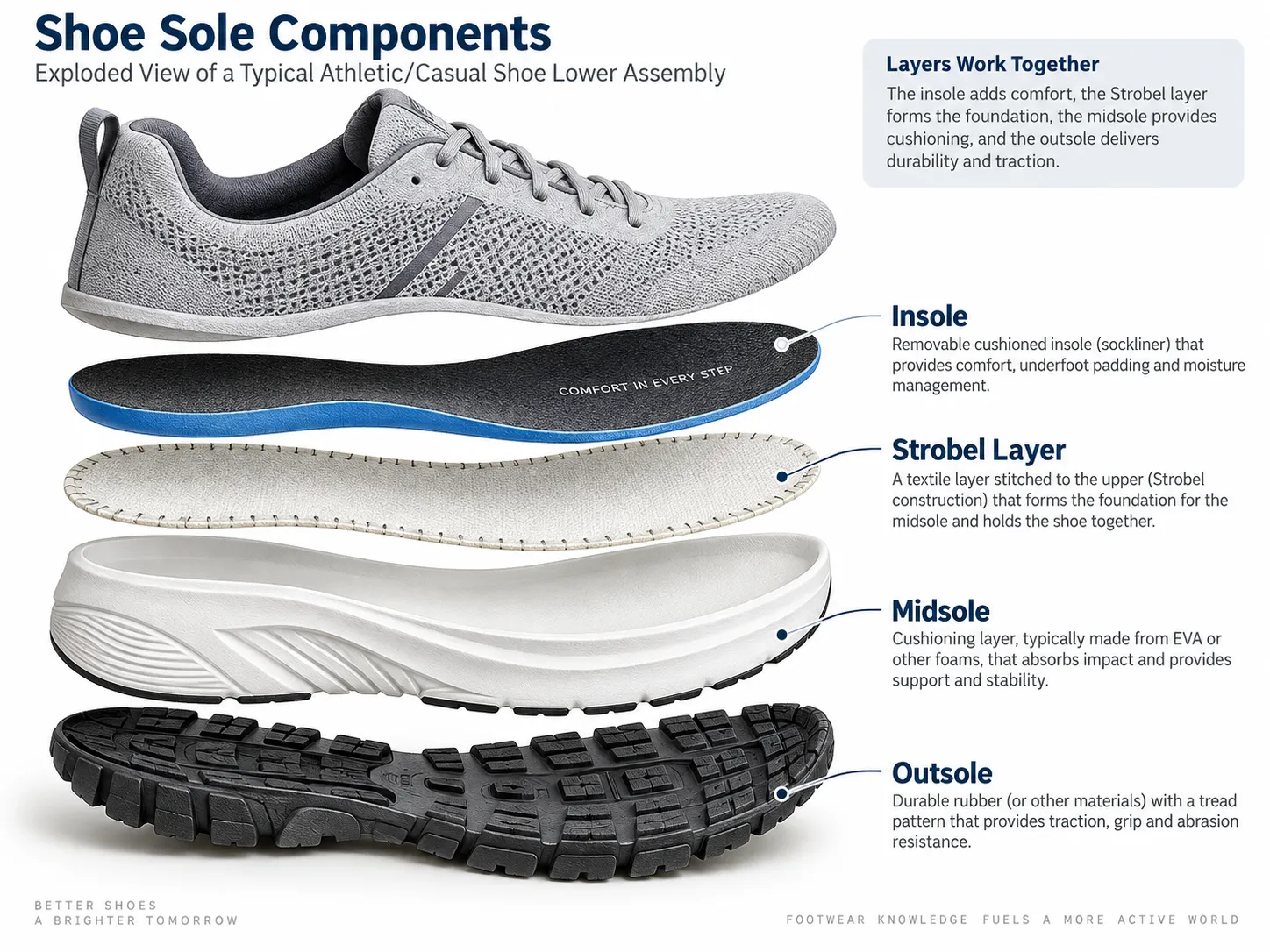
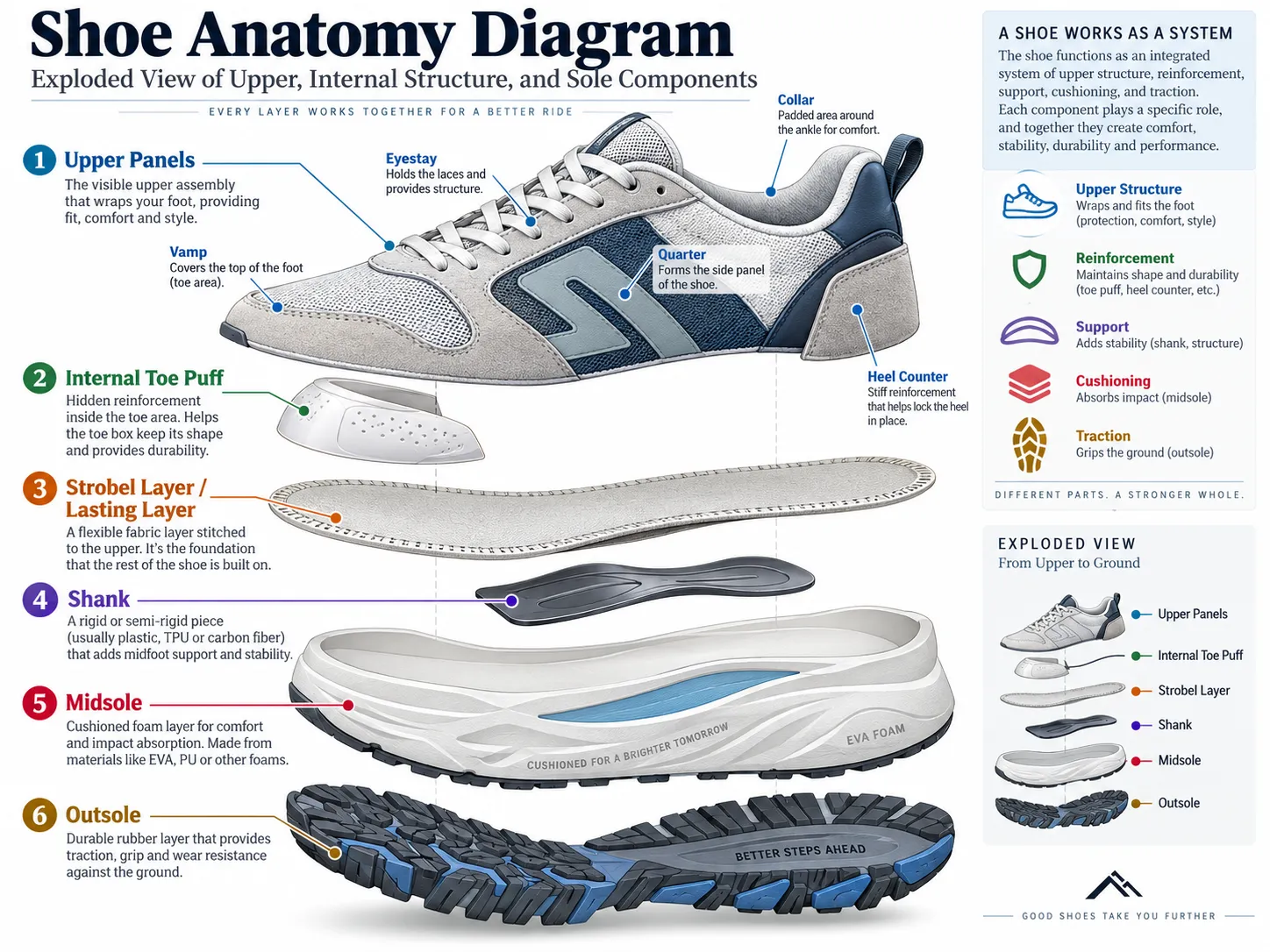
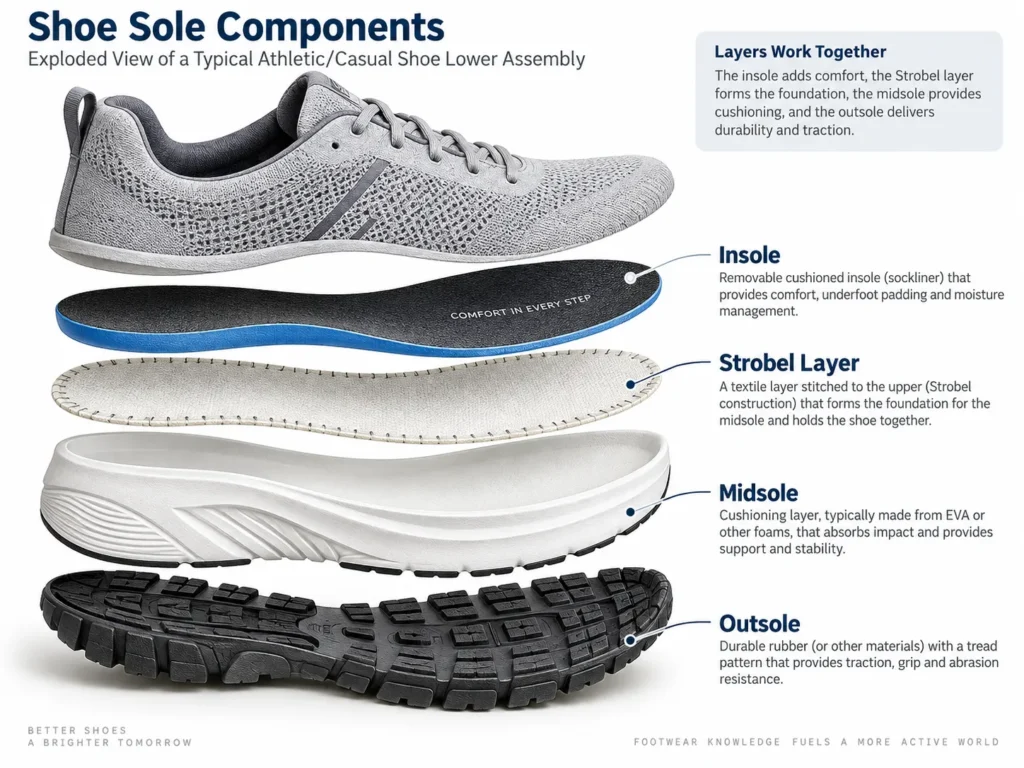
The outsole meaning is easiest to understand by position. A shoe is built in layers: the upper wraps the foot, the insole sits under the foot, the midsole (if there is one) cushions, and the outsole is the outermost layer that meets the floor. “Out” means outside — it is the sole layer facing the world. When people simply say “the sole”, they usually mean the outsole, though technically the sole includes every layer under the foot.
◆Outsole vs Midsole vs Insole
Buyers often mix up these three parts, and the difference matters because each one is specified, priced and tested separately. The table summarises insole vs outsole vs midsole.
◆What Does the Outsole Do?
- Grip. The outsole compound and tread pattern create traction on dry, wet, smooth and loose surfaces.
- Wear resistance. It takes the abrasion of every step and protects the softer midsole and insole above it.
- Protection. It shields the foot from sharp objects, heat, cold and water.
- Flex. Its thickness, hardness and flex grooves decide how easily the shoe bends at the ball of the foot.
- Look and identity. Sidewall height, colour and tread design are part of the shoe’s style — and often part of the brand.
If you are new to footwear terms, our guide to the parts of a shoe shows where the outsole sits among the upper, lining, insole and midsole.
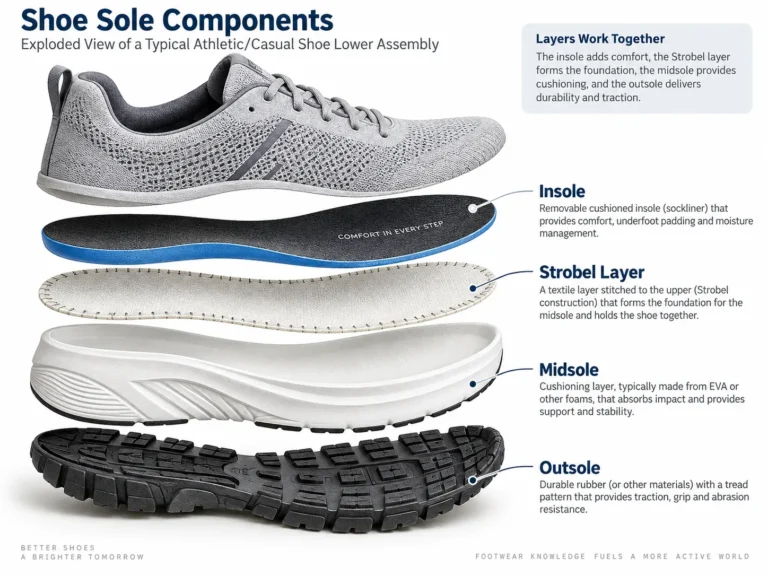
The sole as a stack: insole, strobel or board, midsole and outsole.
⭐Why the Outsole Matters for Brands and Buyers
For a brand, the shoe outsole is where safety, durability, design and cost meet. A good upper on the wrong sole still produces returns, and a sole chosen late in development often forces compromises in the last, the pattern or the price. Here is why the outsole deserves attention at the very start of every project, and what a buyer should decide before the first sample is made.
◆Grip and Safety
Customers rarely praise a sole’s grip, but they always notice when a shoe slips. For slippers worn on tiles, shoes for older customers and outdoor footwear, grip is a safety feature and a liability question. A sole that performs well on dry pavement can still slip on a wet kitchen floor, so the target surfaces should be named in the brief.
◆Durability and Returns
Premature wear at the heel or forefoot, sole separation and cracking in the flex zone are among the most common reasons footwear comes back. Each has a root cause in material choice, hardness, thickness or bonding — all of which can be specified before production rather than discovered in customer reviews.
◆Look and Brand Identity
From the side, the outsole defines the silhouette: a thin vulcanized foxing reads as classic, a tall cupsole as streetwear, a chunky lugged sole as outdoor. From underneath, a molded logo and a distinctive tread pattern carry the brand onto every surface the shoe walks on.
◆Mold Cost and Lead Time
The shoe outsole is usually the biggest tooling item in a footwear project, because every size needs a mold cavity. Whether you use a factory’s existing mold or open your own affects the first-order budget, the sampling speed and how exclusive your product is — a decision we cover in detail later in this guide.
In practice, a buyer should settle four things before sampling: the surfaces the shoe will be worn on, the wear life customers expect, the look of the sole from the side and underneath, and whether the sole needs to be exclusive. Those four answers narrow the material, the pattern and the mold choice to a short list the factory can sample quickly.
🗂️Main Types of Shoe Outsoles
Types of shoe soles are usually grouped by how the outsole is made and how it is joined to the upper. The construction affects the look, the feel, the durability and the tooling required.
◆Cemented Unit Soles
A unit sole is molded on its own, then cemented to the lasted upper: the bottom of the upper is roughed, both surfaces are primed and glued, and the sole is pressed on. This is the most flexible construction for design, because the sole can combine several materials and colours. Its weak point is bonding, so adhesion is the key quality control step.
◆Cupsoles
A cupsole is a rubber sole with raised sidewalls that wrap around the bottom of the upper. It is cemented and often stitched through the sidewall for extra security. Cupsoles feel firm and stable and give the clean, defined profile of court and skate sneakers.
◆Vulcanized Rubber Soles
In vulcanized construction, a thin rubber outsole and a strip of rubber foxing are applied around the upper, then the whole shoe is cured with heat. The result is flexible and close to the ground — the classic canvas sneaker. The foxing is part of the look, so its height and texture should be agreed with the sole.
◆Direct-Injected Soles
In direct injection, the lasted upper is placed in a mold and the sole material — often PU, PVC, TPR or TPU — is injected so it bonds directly to the upper. There is no separate glue line, which makes it efficient and well suited to slippers, sandals and many work and casual styles. Our article on injection molding in footwear manufacturing explains how the process works and how it compares with cemented construction.
◆Combination Soles
A combination sole uses a light material for the body — usually EVA or PU — and adds rubber only where the shoe needs grip and wear resistance, such as the heel and forefoot. It is a common way to save weight without giving up traction, and it lets designers use different colours and textures in one sole.
🧪Outsole Materials Compared: Rubber, EVA, TPR, TPU and PU
Outsole materials are the most important choice after construction. Each material trades grip, weight, wear, flexibility and cost differently. The table gives a practical comparison; real performance always depends on the exact compound, hardness and thickness.
◆Rubber
Rubber — natural, synthetic or blended — is the benchmark for grip and durability. Harder carbon-filled rubbers last longer on pavement; softer compounds grip better on wet rock and smooth floors but wear faster. Rubber is heavier than foams, so lightweight shoes often use it only in high-wear zones.
◆EVA
An EVA sole is extremely light and soft, which is why EVA dominates midsoles and one-piece slides. As an outsole, plain EVA wears quickly and can be slippery on wet surfaces, so it is often protected with rubber pods or used for indoor and beach styles. EVA also shrinks slightly after molding, which makes dimensional control part of every EVA sample.
◆TPR
Thermoplastic rubber (TPR) behaves like soft rubber but can be injection molded, which keeps cost down and makes complex patterns easy. It gives good everyday grip and flexibility and is widely used for slippers, kids’ shoes and casual footwear. It is less wear-resistant and heat-resistant than vulcanized rubber.
◆TPU
A TPU sole is tough and highly abrasion-resistant, keeps its shape well and can be made in clear or bright colours. It is stiffer and heavier than TPR or EVA, so it is used where durability matters most — for example the TPU soles on our open-back wool slippers, heel caps and toe guards on outdoor shoes, and soles meant for indoor-outdoor use.
◆PU
A PU sole (polyurethane) can be made light and cushioned or dense and hard-wearing, depending on its formulation. It is common in comfort shoes, work shoes and many direct-injected styles. PU needs good storage and handling because some formulations can degrade over long periods, so date-coded batches and a clear shelf-life policy are sensible for slow-moving stock.
◆EVA vs Rubber Sole
The EVA vs rubber sole question comes up in almost every project. EVA wins on weight and softness; rubber wins on grip, wear and wet-floor safety. For shoes that will be worn mostly indoors or on sand, EVA alone can be enough. For anything worn on wet streets, ramps or stairs, specify rubber at least in the heel and forefoot contact areas — or choose TPR or TPU for slippers that go outside.
◆Recycled Content and Blended Compounds
Many outsole compounds can include recycled rubber or regrind from production, and blends such as EVA-rubber combine lightness with better grip. Recycled content usually changes hardness, colour consistency and abrasion results, so treat a recycled sole as a new material: test it, approve a reference sample and write the recycled percentage into the specification.
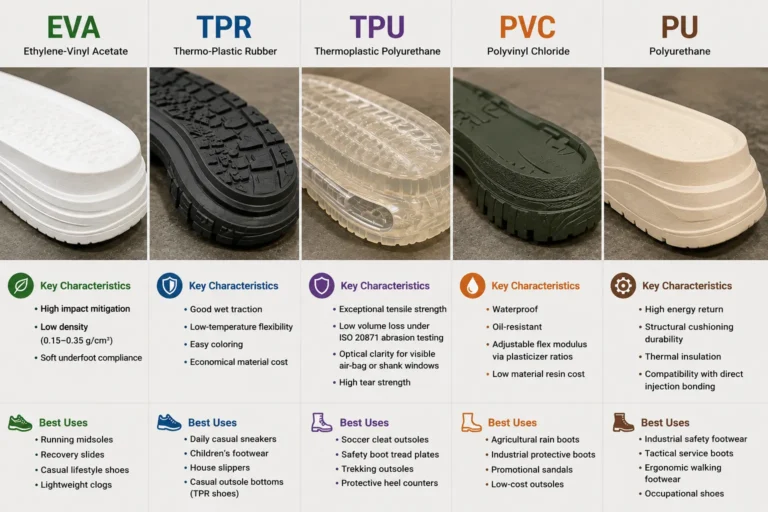
Common outsole materials side by side, with their key characteristics and uses.
🏭Factory experience — 2026, SeeU Shoe development workshop, China
In our EVA outsole sampling, I measured one sole immediately after molding at 28.85 mm and 27.68 mm at two controlled points, and both readings were within our approved tolerance. This is why we do not judge EVA only by appearance — we check post-molding dimensions at fixed points before approving the sole for the next development step, and we record the readings with the sample so later batches can be compared against the same points.
📏How to Read Outsole Specs: Hardness, Density, Abrasion and Weight
A shoe outsole specification turns “durable and grippy” into numbers a factory can produce and a lab can check. These are the properties buyers see most often, what they mean, and how to use them.
◆Hardness (Shore A)
Outsole hardness is measured with a durometer and reported on the Shore A scale. A lower number means a softer sole: softer compounds generally grip better, especially on wet surfaces, but wear faster; harder compounds last longer but can feel slippery and stiff. Ask for a hardness range rather than a single value, and confirm it is measured on the finished sole, not only on a lab slab.
◆Density and Weight
Density (grams per cubic centimetre) is especially important for foamed soles such as EVA and PU, because it drives both weight and cushioning. A lower-density sole is lighter and softer but compresses and wears faster. On a spec sheet, state the target density range and the weight of a single sole at your sample size — weight is easy for anyone to check on receipt.
◆Abrasion Resistance
Abrasion resistance tells you how much material the sole loses under controlled rubbing. As specified in ISO 4649:2024, rubber abrasion resistance is determined with a rotating cylindrical drum device, and the result is recorded as volume loss — the smaller the loss, the more wear-resistant the compound. For buyers, the point is comparability: when two suppliers quote abrasion results by the same method, you can compare them; when they use different methods, the numbers mean little side by side.
◆Flex and Tear Strength
Flex testing repeatedly bends the sole at the ball to check whether cracks start in the flex zone; tear strength shows how well the material resists a cut or nick spreading. Both matter most for thin, flexible soles and for soles with deep flex grooves, where cracks usually begin.
🏭Certification experience — SeeU Shoe factory, China
During our preparation for our ISO 9001 quality management system, we standardized outsole inspection records for hardness, dimensions, material identification and visual defects. Each batch had to be checked against approved specifications before release, with measurement results recorded for traceability — so if a buyer questions a later batch, we can show the readings that batch was released on.
◆How to Write Outsole Specs in a PO
Keep the outsole section of your PO or spec sheet short but complete. Name the material and compound reference, hardness range, density (for foams), colour reference, tread pattern or mold number, test requirements and the approved reference sample. The example below shows the format we recommend.
📝 Example: outsole section of a spec sheet
Outsole: rubber, compound ref. [ ] · mold no. [ ] (private / public)
Hardness: [ ]–[ ] Shore A on finished sole · Colour: [Pantone ref.]
Sole weight: [ ] g at sample size EU [ ] (±[ ] g)
Tests: slip resistance and abrasion on trial pairs; bond strength on pre-production pairs
Size coverage: EU [ ]–[ ], mold sizes as quoted
Approval: matches sealed reference sample dated [ ]
🧭Tread Patterns and Traction: How Outsoles Grip
Shoe outsole traction comes from two things working together: the compound and the tread pattern. The pattern controls how the sole meets the surface; the compound controls how it holds once it is there.
◆Lug Depth and Spacing
Lugs are the raised blocks on the outsole. Deep, widely spaced lugs bite into mud, gravel and snow and shed debris instead of clogging. On hard, smooth surfaces, though, deep lugs reduce the contact area and can feel unstable. Lug depth and spacing should therefore follow the terrain the customer actually walks on, not the most rugged image.
◆Siping and Edges
Sipes are thin cuts in the tread that open as the sole flexes, creating extra edges that wipe water away and grip on wet, smooth floors. Edge design matters too: sharp-edged blocks grip better on wet surfaces than rounded ones. Many slip-resistant work and comfort soles rely on fine siping rather than deep lugs.
◆Flat, Herringbone and Waffle Patterns
A flat or micro-textured pattern gives maximum contact area and suits indoor floors. Herringbone provides multidirectional grip for courts and everyday sneakers. Waffle and block patterns grip well on mixed surfaces and give a recognisable footprint. The right choice depends on surface, sport and style.
📌Industry case — how one tread pattern built a brand
In 1971, Nike co-founder Bill Bowerman was trying to solve a traction problem on the new urethane track at the University of Oregon: spikes dug in too deep, and flat soles did not bite enough. At breakfast he noticed the grid on his wife’s waffle iron, poured urethane into it — ruining the iron — and kept experimenting with more irons until the pattern worked. The result was the “Moon Shoe” made for the 1972 U.S. Olympic Trials, followed in 1974 by the Waffle Trainer, which helped drive the company’s early growth (source: NIKE, Inc., “The History of the Nike Moon Shoe”). The lesson for brands today is that a tread pattern solves a real traction problem and, once it works, becomes an asset in its own right. Patterns built into a private mold stay with the brand; patterns on a shared mold can appear on anyone’s shoe.
◆Compound vs Pattern: Which Matters More?
On wet, smooth surfaces, the compound usually matters more: a soft, well-formulated rubber with fine edges outperforms a hard compound with an aggressive pattern. On loose ground, the pattern matters more, because lugs need to penetrate and shed mud. In practice, you choose the pattern for the terrain and the compound for the surface conditions, then confirm both with testing.
◆Indoor vs Outdoor Outsoles
Indoor soles — slippers, house shoes, kids’ indoor shoes — need grip on tiles, laminate and wood, a quiet step and no marking. Outdoor soles need wear resistance and water shedding. Indoor-outdoor products such as open-back slippers need a balance of both, which is why we pair them with TPU soles and a moderate pattern. For performance footwear, our page on outdoor and sports shoe development explains how lug depth, rubber wrap and outsole molds are matched to terrain.
⚠️Slip Resistance Testing for Outsoles
“Non-slip” is not a material; it is a test result. A slip resistant outsole is one that achieves an agreed friction result on agreed surfaces, measured by an agreed method. Without those three elements, the claim cannot be checked.
◆What a Slip Test Measures
Slip tests measure the coefficient of friction (CoF) between the sole and a test surface: the higher the value, the more resistance to slipping. Tests are run on defined surfaces, such as ceramic tile or steel, with defined contaminants, such as water with detergent or glycerol, and on both the flat forefoot and the heel, because people slip in both positions.
◆ISO 13287
ISO 13287 is the international reference method most footwear labs use for slip testing, and it is the one we recommend naming when a buyer and factory need results that can be compared over time.
📊Industry standard — ISO 13287:2019
According to ISO 13287:2019, published in October 2019, the standard specifies a test method for the slip resistance of footwear, and for product development purposes sole units, outsoles and other soling components may be tested. That makes it useful well before bulk production: a brand can compare outsole compounds and patterns at sampling stage instead of discovering a slip problem after launch. ISO 13287 was written for personal protective footwear, so for fashion, comfort and slipper styles it is best used as a consistent comparison method rather than a certification claim.
◆ASTM F2913 and Other Methods
In the North American market, ASTM F2913 is a widely used whole-shoe test method for measuring the coefficient of friction of footwear, and SATRA also runs footwear slip testing. Methods differ in surfaces, contaminants and load, so results from different methods should not be compared directly. Agree the method with your lab and your factory at the start.
◆How We Test Slip and Abrasion on Trial Pairs
In our factory, slip resistance and abrasion are tested in-house on trial pairs before bulk. The steps are simple and repeatable:
- Step 1. Take trial pairs from the actual outsole mold and compound, not substitutes.
- Step 2. Run the slip check on the forefoot and heel positions on the agreed surfaces.
- Step 3. Run abrasion on sole material from the same batch.
- Step 4. Record results against the sample reference and the batch number.
- Step 5. If results fall short, adjust compound hardness, siping or pattern and retest before approval.
📊Industry data — CDC Older Adult Falls Data
Slip resistance is not an abstract specification. The U.S. Centers for Disease Control and Prevention reports that over 14 million, or 1 in 4, older adults report falling every year, and that falls are the leading cause of fatal and nonfatal injuries among older adults (CDC, Older Adult Falls Data, updated September 2026). Footwear is one factor among many, but for senior, medical and comfort footwear, outsole traction and slip testing deserve the same attention as fit.
◆What Reports Buyers Should Ask For
Ask for slip results that name the method, surface, contaminant and positions tested; abrasion results with the method named; hardness readings on the finished sole; and, for retail programmes that require it, a third-party lab report. Keep the report with the sealed sample so it stays tied to the approved outsole.
🏷️Matching the Outsole to the Shoe Category
Each category puts different demands on the shoe outsole. The table gives a starting point; the brief and testing then refine it.
◆Casual Sneakers
Casual sneakers usually use rubber cupsoles, vulcanized rubber or cemented rubber-and-EVA unit soles. Abrasion at the heel and toe and the bond line at the toe are the main risks. Sidewall height and texture carry much of the style.
◆Hiking and Outdoor
Outdoor outsoles need lugs suited to the terrain, a compound that grips on wet rock, and often a rubber toe wrap. TPU is used for heel caps and protection. These soles are usually where brands gain most from a private mold.
◆Slippers and Comfort
Slipper and comfort soles must grip on smooth indoor floors, stay quiet and not mark. TPR and TPU are common for indoor-outdoor styles, EVA for light indoor slides. Footbed and sole are developed together, because a soft footbed changes how the sole contacts the floor.
◆Medical and Senior Shoes
For medical and senior footwear, the outsole should offer a wide, stable base, a gentle toe rise for easier rollover and slip resistance proven by testing. Heavy, aggressive lugs are rarely needed; broad contact and fine siping usually serve these wearers better.
◆Kids’ Shoes
Children’s soles need flexibility so the foot can move naturally, a moderate pattern for playground grip and good abrasion resistance at the toe, where kids drag their feet. Lightweight TPR and rubber are typical choices.
📐How the Outsole Must Match the Shoe Last
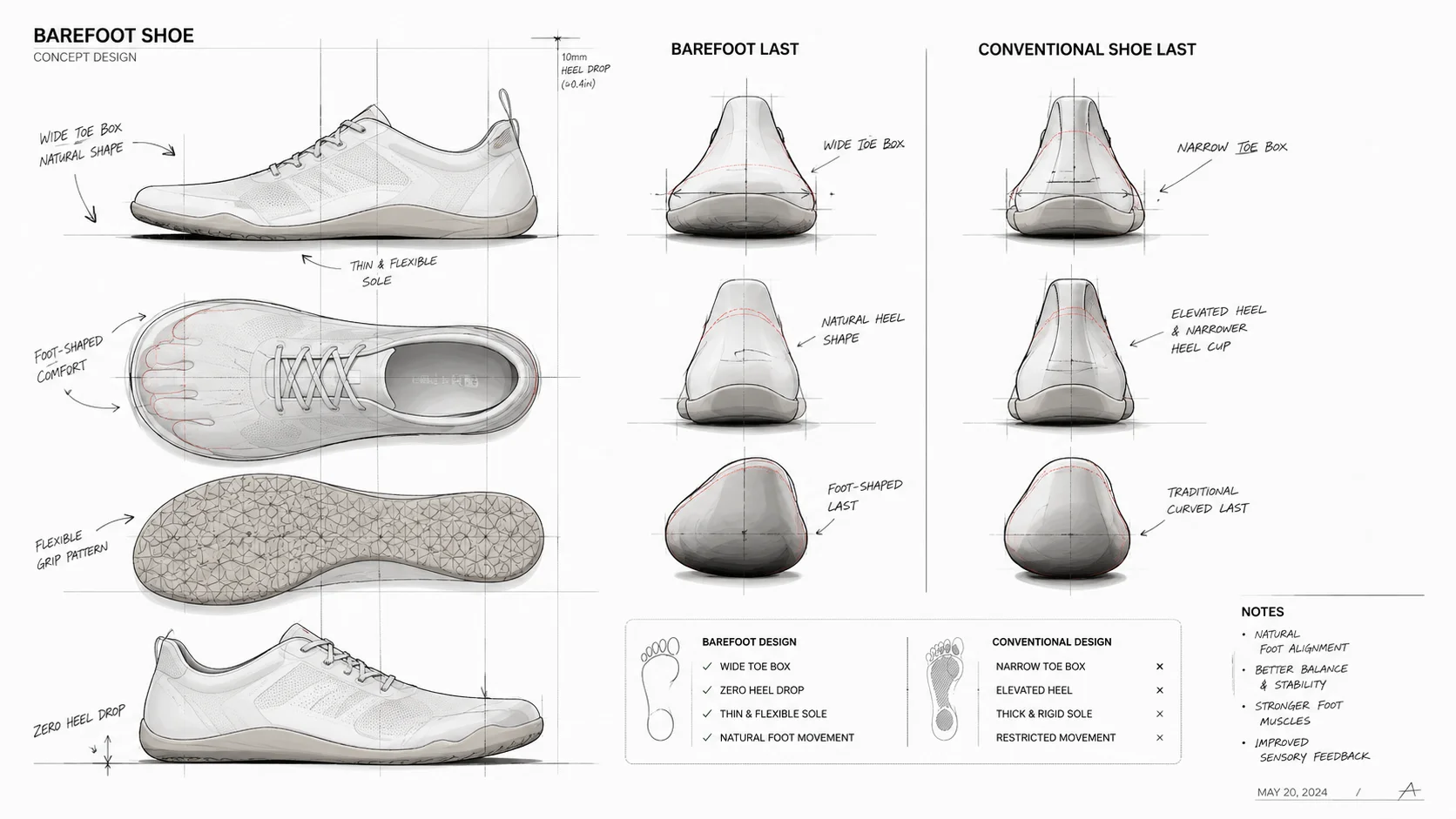
A shoe outsole is not chosen in isolation. It has to fit the bottom of the shoe last exactly, because the upper is lasted to that shape and the sole is bonded to it. When the two are developed separately — a new last paired with an old sole, or a new sole designed from a photo — most of the fit and bonding problems in this guide begin.
The practical rule is to approve them as a pair. Fit the sole to the last before the first sample, check the bond line on the first pairs, and record the last number and the mold number together on the spec sheet so production always uses the matching set.
◆Last Bottom, Heel Height and Toe Spring
The outsole must follow the last’s bottom outline, its heel height and its toe spring — the lift at the front of the shoe. If any of these differ, the sole will leave gaps at the bond line or force the upper out of shape. When a factory proposes an existing outsole for your design, ask which last it was made for and whether your last shares the same bottom.
◆Outsole Sizing and Mold Coverage
Outsole molds are made per size or per pair of neighbouring sizes, depending on the construction and how much the sole changes between sizes. Fewer molds reduce tooling cost; more molds give a closer fit in every size. Confirm the mold coverage in the quote so you know exactly what a “mold set” includes.
◆What Happens When They Don’t Match
Mismatches show up as gaps or squeezed glue at the bond line, distorted toes, a heel that sits off-centre, a shoe that rocks on a flat surface or early sole separation. The shoe last and the outsole should therefore be approved together; our guide to the shoe last explains how the last bottom is defined and checked.
⚖️Public Mold vs Private Mold: How to Choose an Outsole Mold
Every shoe outsole comes from a mold. The key commercial question is whether that mold belongs to the factory or to your brand — because that decides cost, speed, exclusivity and what you are allowed to change.
◆What Is a Public Mold?
A public mold is an existing outsole mold owned by the factory and available to every buyer. We keep more than 800 sole molds in our library. Because nothing new has to be made, a sample on a public mold takes three to seven days and costs from US$28 per pair, depending on the complexity of the last.
◆What Is a Private Mold?
A private mold is made for one brand and belongs to that brand. The last can be adjusted, the sole shape, tread and sidewall drawn for your design, and your logo cut into the mold. It is used only for your orders.
◆Cost and Lead Time
A private outsole mold starts from US$700, priced by the complexity of the last and sole, and takes seven to fifteen days to make, followed by a mold-trial sample. Molds are made by size, so confirm in the quote which sizes the mold set covers. Sample fees are credited against bulk orders.
◆When a Public Mold Is Enough
A public mold is enough when you are testing a design or price point, when your brand identity lives in the upper and materials, when the sole profile is a standard one your customers expect, or when quantities are still small.
◆When to Open a Private Mold
Open a private mold when the sole is part of your product identity, when a competitor could otherwise sell the same bottom under another label, when you need a specific tread or stack height, or when you plan repeat orders on the same platform. For most brands, the practical route is to sample first on a public mold, prove the design, then open the private mold for launch. Our custom casual shoes page shows how that route works for sneakers. How this choice fits the wider OEM vs ODM decision is covered in a separate guide.
🏭Project case — 2026, SeeU Shoe sample workshop, China
In one outsole fitting project, the first trial showed uneven edge contact between the sole and upper around the toe area. We corrected the sole-to-last matching before the next sample, then rechecked bonding contact, edge alignment and overall fit before approving the revised version. Catching it at the trial stage meant the correction was made once, before any production molds were committed.
◆Who Owns the Mold, and How to Write It
Ownership should never be assumed. Put it in writing on the PO or a tooling agreement: the mold number, the sizes covered, the price paid, that the mold is the brand’s property, that it will be used only for the brand’s orders, and what happens to it if production moves. Ask for photos of the finished mold with its number before paying the balance.
🛠️How a Custom Outsole Is Developed, Step by Step
Developing a custom shoe outsole follows a fixed sequence. Each step produces something the buyer can review — a brief, a drawing, a mold, a trial pair, a test report — so decisions are made on evidence rather than on photos. Here is the process we use, step by step.
◆Step 1: Brief and Reference Sole
Start with the shoe category, target surfaces, desired look and a reference sole if you have one. State the priorities in order — for example “wet grip first, then weight, then cost” — because they decide material and pattern.
◆Step 2: 2D and 3D Design on the Last Bottom
The designer draws the outsole on the approved last bottom, defining outline, sidewall, tread, flex grooves and logo position, then builds a 3D model. Review the drawing with views from the bottom, side and heel before anything is cut.
◆Step 3: Mold Making
The mold is machined, usually by CNC, in steel or aluminium depending on the process and expected volume. Aluminium is faster to machine; steel lasts longer under high volumes and pressure. The quote should state material, sizes and lead time.
◆Step 4: Mold Trial and First Soles
The first soles from the mold are checked for fill, flash, surface finish, dimensions and logo clarity, then fitted to the last and the upper. Small adjustments to the mold are normal at this stage.
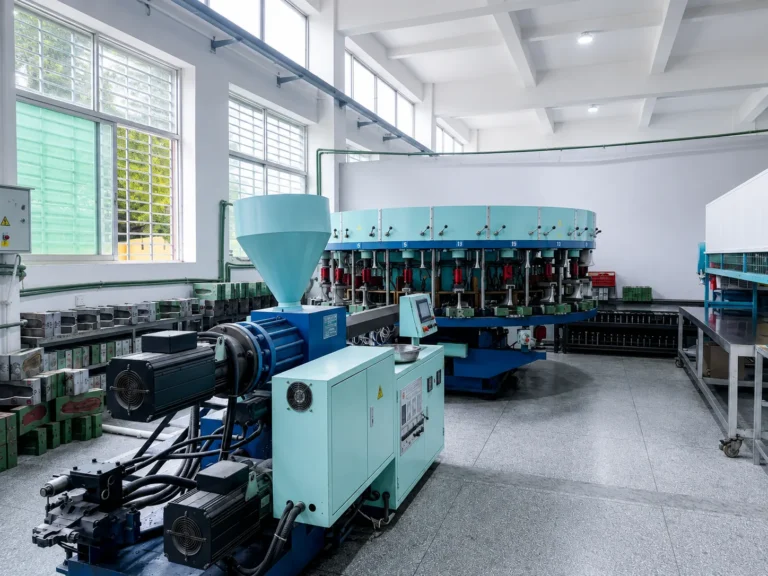
Outsoles are molded on injection machines in our factory before mold-trial pairs are made.
◆Step 5: Testing
Mold-trial pairs are tested for slip resistance and abrasion, and the sole-to-upper bond is checked on finished shoes. Results are recorded against the mold number and the sample reference.
◆Step 6: Full Size Run and Production
Once the sample size is approved, the remaining sizes are produced from the mold set, fit-checked at the smallest and largest sizes, and released for bulk with the sealed sample as the reference.
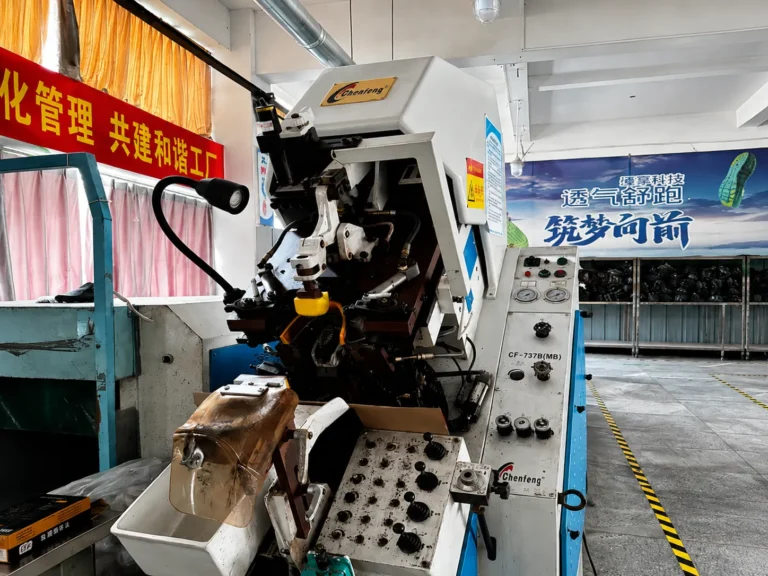
Sole pressing after cementing applies even pressure along the whole bond line.
🔍Common Outsole Quality Problems and How to Prevent Them
Most shoe outsole problems are predictable, and most can be prevented with the right specification and checks at sampling, rather than sorting in the warehouse after delivery.
◆Sole Separation
Separation usually starts at the toe or the heel, where the upper bends most. It comes from poor surface preparation, adhesive problems, insufficient pressing or a sole that does not match the last bottom. Bond testing on trial pairs and controlled pressing prevent most cases.
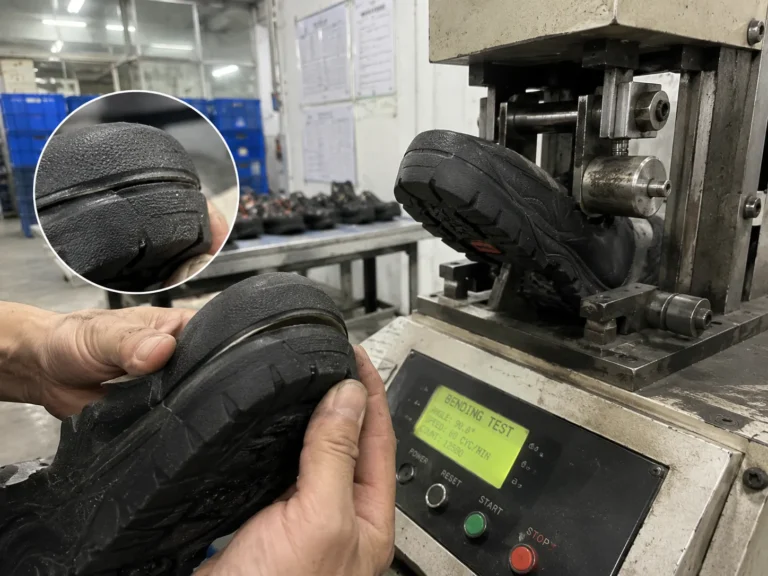
Toe-area separation: the defect bond testing and correct sole-to-last matching are designed to prevent.
◆Premature Wear
Soles wear out early when the compound is too soft for the use, or when the material is too thin where the foot strikes. Check wear zones on a worn sample and add thickness or harder rubber there.
◆Slipping on Wet Floors
Wet slipping is mostly a compound and edge problem. Softer compounds, sipes and sharper block edges help; slip testing on the actual target surfaces confirms the fix.
◆Shrinkage and Size Drift
Foamed soles can change dimensions after molding. Measure at fixed points and at a fixed time after molding, and compare every batch with the approved readings.
◆Blooming and Colour Variation
Blooming is a whitish film that appears when compound ingredients migrate to the surface. Colour variation comes from batch differences. An approved colour standard and batch control keep both in check.
◆Flash and Poor Trimming
Flash is excess material along the mold’s parting line. It points to mold wear or overfilling and should be removed cleanly and checked in visual inspection.
✅Outsole Specification Checklist for Your PO
Use this checklist to make sure your PO or spec sheet covers everything the factory needs to produce — and you need to inspect — the shoe outsole you approved. Fill in every line before bulk; a blank line is a decision left to someone else.
❓Frequently Asked Questions About Shoe Outsoles
◆Is the Outsole the Same as the Sole?
Not exactly. The sole includes every layer under the foot — insole, midsole and outsole — while the outsole is only the bottom layer that touches the ground. In everyday speech, people often use “sole” to mean the outsole.
◆What Is the Best Outsole Material?
There is no single best outsole material; it depends on use. Rubber is the benchmark for grip and durability, EVA for light weight, TPR for affordable everyday grip, TPU for abrasion resistance and PU for cushioned comfort and work shoes.
◆Is EVA or Rubber Better for a Shoe Sole?
Rubber is better for grip, wear and wet floors; EVA is better for weight and softness. Many shoes combine them, using EVA for the body and rubber where the sole touches the ground most.
◆Are TPR Soles Good?
Yes, for many everyday uses. TPR gives good grip and flexibility at a low cost and is ideal for slippers, kids’ shoes and casual styles, though it wears faster and handles heat less well than vulcanized rubber.
◆What Is a TPU Sole?
A TPU sole is made from thermoplastic polyurethane, a tough, abrasion-resistant material that keeps its shape. It is stiffer and heavier than TPR or EVA and is used where durability matters, such as indoor-outdoor slippers and outdoor shoe protection.
◆Is a PU Sole Durable?
A well-made PU sole is durable and comfortable, especially in denser formulations used for work and comfort shoes. Ask about storage and shelf life for slow-moving stock, because some PU formulations can degrade over long periods.
◆What Makes an Outsole Non-Slip?
A slip resistant outsole combines a suitable compound, edges and siping that clear water, and a pattern matched to the surface — and proves it with a slip test that names the method, surface and contaminant.
◆How Much Does a Private Outsole Mold Cost?
At our factory, a private outsole mold starts from US$700, priced by the complexity of the last and sole. Confirm how many sizes the quoted mold set covers, and that the mold is recorded as your brand’s property.
◆How Long Does a Custom Outsole Take?
Making a private mold takes about seven to fifteen days, followed by a mold-trial sample and testing. Samples on existing public molds take three to seven days, so most brands sample first and open the private mold once the design is approved.
◆Can an Outsole Be Replaced?
On some constructions, yes — stitched and many cemented soles can be resoled by a cobbler. Vulcanized and direct-injected soles are bonded too closely to the upper for practical replacement, so durability should be designed in from the start.