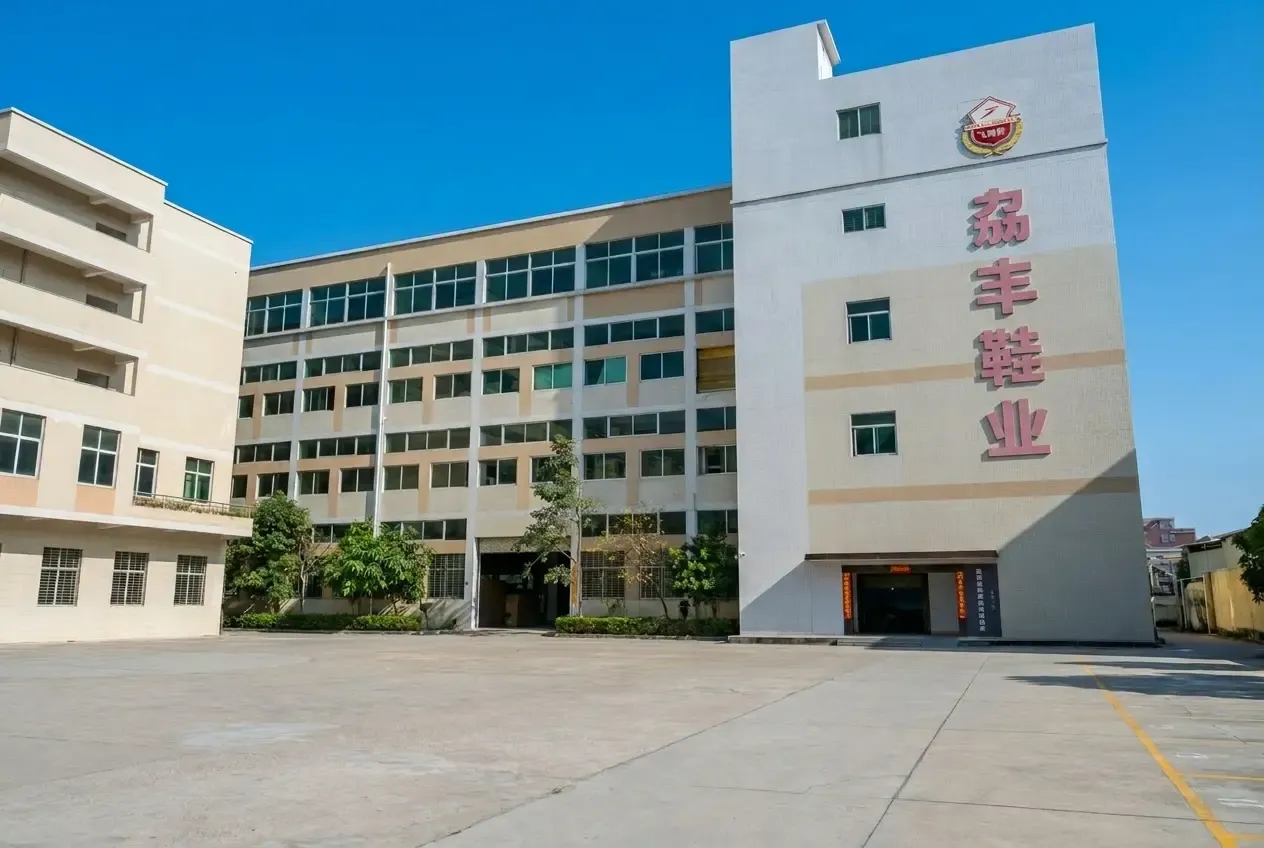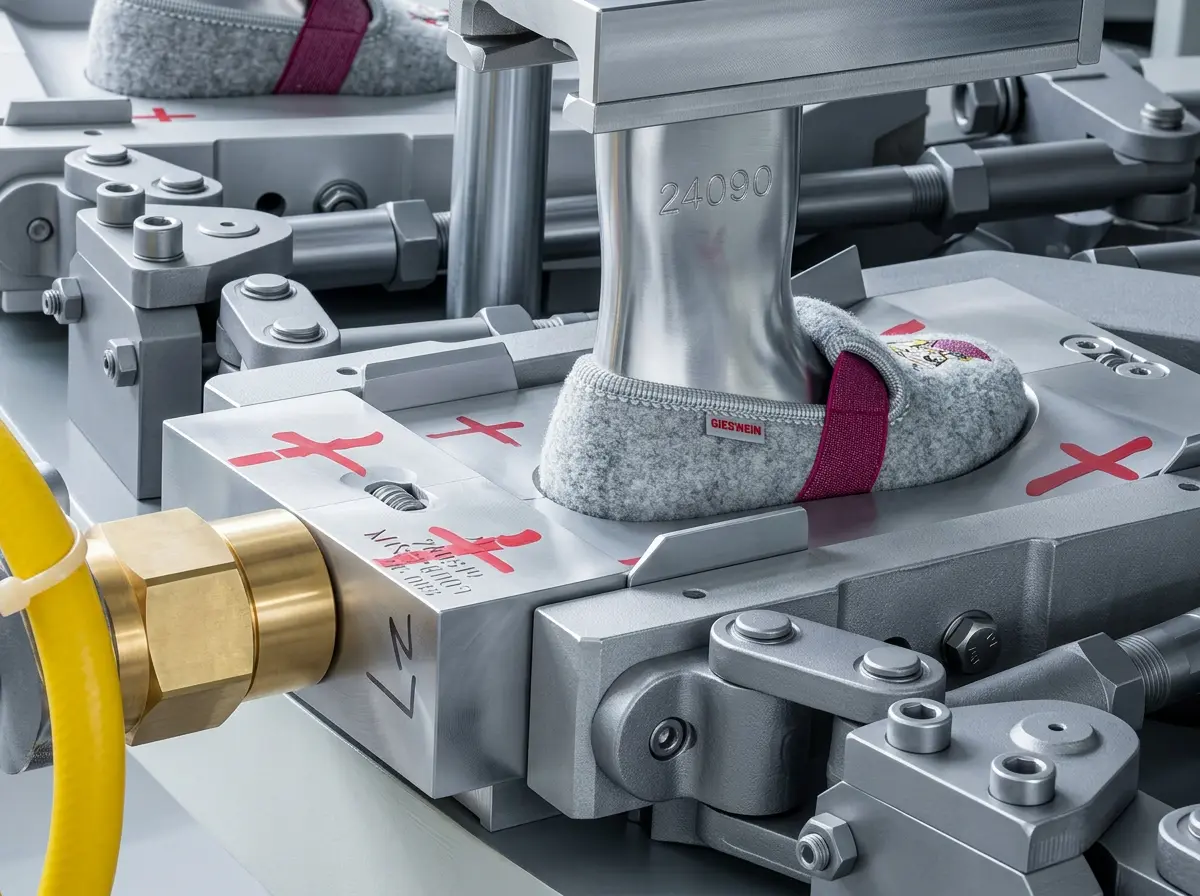

🚀 How to Find Shoe Manufacturers in China: The Ultimate Sourcing Guide
Learning how to find shoe manufacturers in china is one of the most critical operational milestones for growing footwear brands, B2B importers, and private label footwear retailers. China remains the world’s undisputed powerhouse for footwear production, offering unmatched supply chain integration, skilled tooling artisans, and scalable mass manufacturing capabilities. However, navigating the vast market of shoe manufacturers in china requires a structured sourcing strategy to filter out intermediaries, mitigate quality risks, and secure competitive pricing. This comprehensive guide details every step of the sourcing lifecycle—from preparing technical specifications and verifying factory legitimacy to managing prototype development and auditing production lines.
Key Insight: Sourcing directly from Chinese manufacturers eliminates middleman markups, but requires rigorous factory vetting and comprehensive technical specifications to protect your intellectual property and profit margins.
🌍 Why China Is Still a Major Shoe Manufacturing Hub
Despite rising labor costs and geographic diversification across Southeast Asia, China maintains a commanding lead in global footwear manufacturing. The primary reason international footwear brands rely on shoe production in china is the unparalleled maturity of its local industrial ecosystems. From raw synthetic leather tanneries and rubber outsole vulcanization plants to last-making workshops and specialized hardware suppliers, everything required for complex shoe making in china is situated within tight geographic clusters.
📦 Complete Footwear Supply Chain
China’s footwear supply chain is entirely self-contained, allowing factories to source outsoles, eyelets, insoles, engineered mesh, and eco-friendly adhesives within a 30-mile radius. This geographic concentration drastically reduces material lead times, minimizes inbound logistics costs, and allows R&D teams to prototype complex footwear concepts in days rather than weeks.
⚙️ Wide Range of Shoe Categories and Manufacturing Processes
Chinese factories possess specialized machinery and technical expertise across every major footwear construction method, including cold bonding, Goodyear welted, injection molding, and vulcanization. Whether producing performance running shoes, safety work boots, or fashion leather heels, shoe making companies in china offer exact technical capabilities tailored to specialized product lines.
🏭 Product Development and Mass Production Capabilities
Footwear facilities in China excel at transitioning complex technical drawings into commercial prototypes through advanced 3D pattern-making and automated CAD last design. Combined with highly efficient assembly lines capable of scaling from trial batches to hundreds of thousands of pairs per month, Chinese suppliers offer operational flexibility matched by few other manufacturing nations.
📊 Market Statistics & Global Output
China remains the world’s largest footwear manufacturing country. According to the World Footwear Yearbook, global footwear production reached massive scale, with Asia accounting for the vast majority of total output. China alone manufactured approximately 13.7 billion pairs, representing over half of global footwear production. These figures show why China continues to offer one of the world’s deepest footwear manufacturing ecosystems, despite the continued expansion of production in countries such as Vietnam and India.
📋 Footwear Construction Methods at a Glance
| Construction Type | Primary Application | Key Advantage |
|---|---|---|
| Cold Cementing | Sneakers, Casual Shoes | Cost-effective, lightweight |
| Goodyear Welt | Work Boots, Formal Footwear | Extremely durable, resoleable |
| Injection Molding | Sandals, Athletic Outsoles | High speed, watertight bond |
| Vulcanization | Canvas Sneakers, Skater Shoes | Flexible, strong rubber fusion |
🎯 Define Your Shoe Manufacturing Requirements First
Before reaching out to suppliers, footwear buyers must define their technical, commercial, and aesthetic requirements. Contacting factories without a clear technical specification sheet signal a lack of industry experience, resulting in inflated quotes, delayed responses, or inaccurate sampling.
Key Insight: Entering supplier negotiations with precise technical blueprints protects your project budget, prevents costly sampling errors, and positions your brand as a professional, serious partner.
🔍 Identify the Type of Shoe You Want to Produce
Footwear manufacturing is highly specialized; a factory equipped for stitching delicate leather dress shoes cannot efficiently produce cold-bonded athletic sneakers or steel-toe safety boots. Clearly establish your primary product category, target performance attributes, upper materials (e.g., full-grain leather, TPU film, recycled polyester mesh), and sole construction (e.g., phylon midsole with rubber tread).
⚖️ Decide Between Existing Styles and Custom Development
Buyers must choose between private labeling off-the-shelf catalog designs or developing custom footwear from scratch. Choosing existing catalog models reduces upfront tooling expenses and speeds up market entry. Conversely, custom footwear development involves creating proprietary shoe lasts, custom outsole molds, and specific upper patterns, requiring higher capital investment and technical oversight.
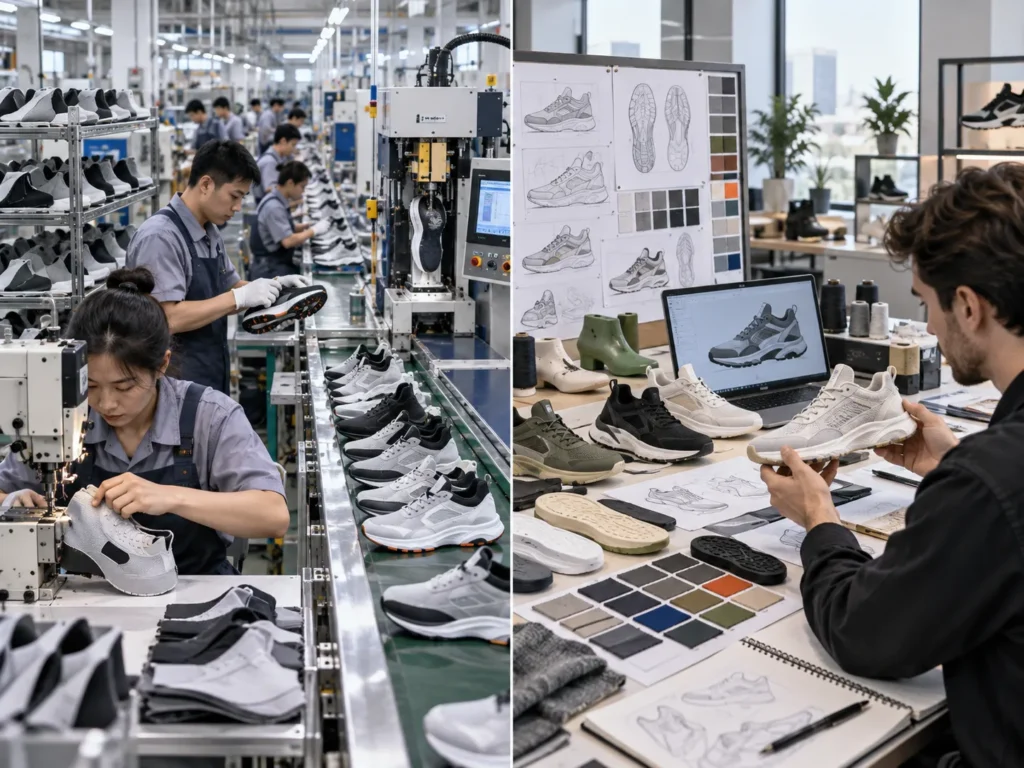
📦 Existing Styles (ODM)
Buyers select pre-developed styles from a factory’s catalog, modifying colors, logos, and insoles to fit their brand identity without mold fees. Explore our specialized ODM Footwear Manufacturing options to streamline off-the-shelf branding.
🛠️ Custom Development (OEM)
The factory builds completely custom shoes based on your proprietary Tech Pack, requiring original last development, pattern grading, and dedicated outsole mold tooling. Review our complete OEM Footwear Manufacturing capabilities for bespoke engineering.
💡 Pro Tip on Strategic Choices
If you are launching a brand for the first time, starting with ODM models allows you to validate market demand with minimal risk before committing thousands of dollars to custom outsole molds and proprietary last tooling.
📋 Prepare Your Basic Product Specifications
Compile a comprehensive Tech Pack that acts as the blueprint for your shoe. A commercial Tech Pack must include detailed orthographic vector drawings, a complete Bill of Materials (BOM) specifying material weight and supplier codes, colorways (Pantone references), sizing charts, stitching specifications (stitches per inch), and logo placement methods (e.g., screen printing, heat transfer, TPU embossing).
💰 Estimate Order Quantity and Target Price
Define your initial order volume per style and per colorway (SKU), along with your target Free on Board (FOB) price. Knowing your target price per pair allows factories to quickly determine whether their cost structure, material sourcing networks, and production line setups align with your commercial budget.
📊 Sourcing Pathway Comparison
| Sourcing Element | ODM (Existing Styles) | OEM (Custom Development) |
|---|---|---|
| Tooling Cost | Low / Zero Mold Fees | High (Lasts & Outsole Molds) |
| Time to Market | Fast (Weeks) | Extended (Months) |
| Minimum Order Quantity (MOQ) | Generally Lower | Higher per Colorway/Style |
| Brand Uniqueness | Moderate (Shared Design) | Exclusive (Proprietary Asset) |
🔍 Where to Find Shoe Manufacturers in China
Locating prospective shoe making companies in china requires utilizing multiple sourcing channels to build a robust candidate list.
Strategic Tip: Diversifying your search channels across digital platforms, international trade fairs, and regional hubs ensures a comprehensive pool of verified manufacturers rather than relying on a single directory.
🌐 Google Search
Using focused search strings on Google allows buyers to bypass generic trading portals and locate direct factory websites. Combine relevant keywords with geographic parameters and industry terms (e.g., “athletic shoe factory” AND “Jinjiang” AND “OEM”, “leather footwear manufacturer” AND “Dongguan”).
🛒 Alibaba and B2B Platforms
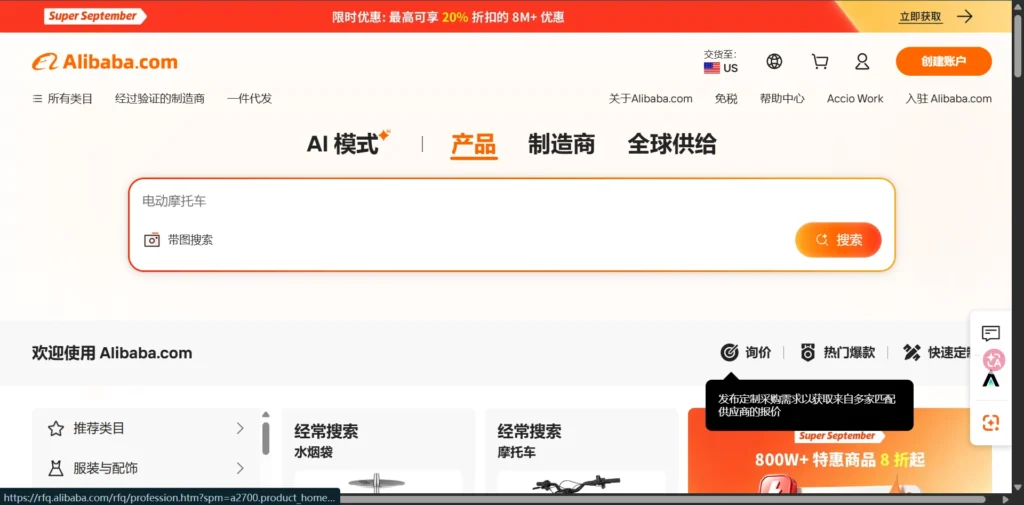
B2B directories such as Alibaba, Made-in-China, and Global Sources host thousands of footwear profiles. When searching B2B portals:
- Filter exclusively for “Verified Suppliers” or “Gold Suppliers” with audited operations.
- Examine supplier profiles for custom tooling capabilities rather than stock resale photos.
- Inspect onsite verification reports conducted by independent third-party inspection firms (e.g., SGS, TÜV Rheinland).
🎟️ Shoe Trade Shows
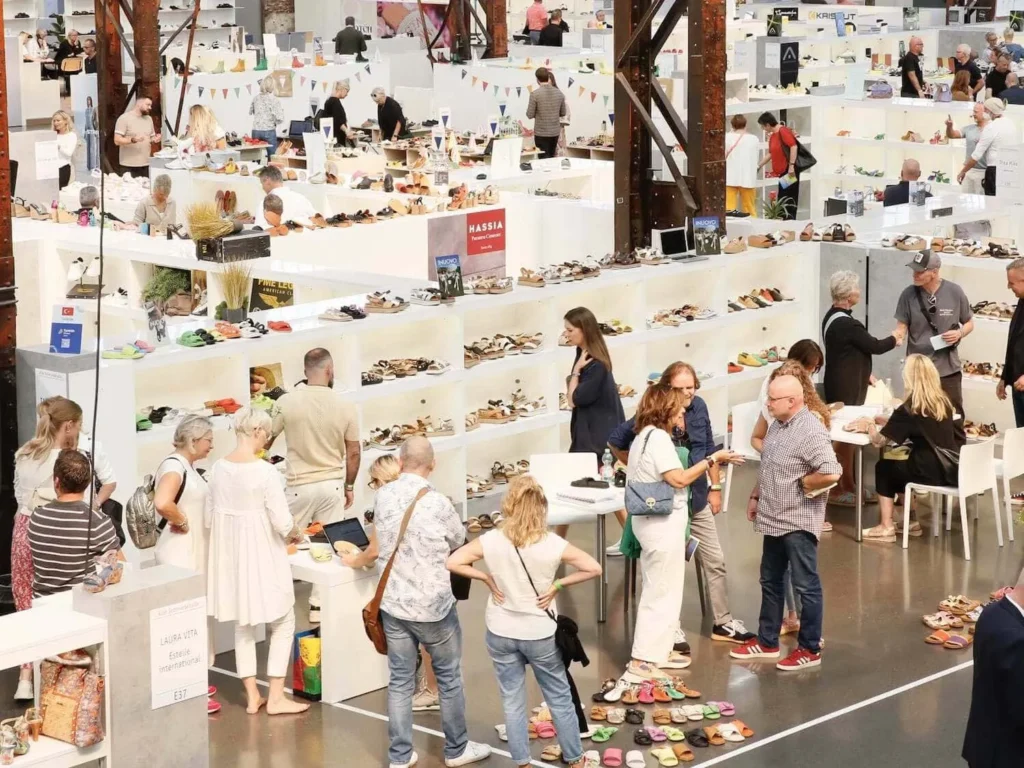
Attending international and domestic Chinese footwear trade fairs provides direct, face-to-face contact with factory management and R&D representatives. Key exhibitions include:
- The Canton Fair (Phase 3 – Shoes Section, Guangzhou): China’s largest import/export fair featuring hundreds of medium and large-scale footwear manufacturers.
- Jinjiang Footwear & Sports Industry International Exposition (Jinjiang, Fujian): The premier global event specifically focused on athletic footwear, materials, machinery, and sole technology.
- East China Fair (Shanghai): Excellent for casual footwear, slippers, and textile-based shoe manufacturing.
🏭 Chinese Footwear Manufacturing Regions
Focus your search on specific regional manufacturing hubs where local specialized labor and component markets are concentrated. Reaching out directly to factories situated within these specialized industrial zones ensures higher production efficiency and material access.
🤝 Sourcing Agents and Industry Referrals
For brands lacking overseas procurement teams, hiring an independent footwear sourcing agent based in China can accelerate supplier identification. Sourcing agents navigate local dialects, perform initial factory audits, negotiate pricing, and oversee inline quality control in exchange for a management fee or commission.
💡 Regional Cluster Analysis
Targeting specific provinces—such as Fujian for athletic shoes, Guangdong for high-end fashion leather footwear, and Zhejiang for casual slip-ons and slippers—dramatically streamlines your geographic filtering process.
📊 Sourcing Channel Comparison
| Sourcing Channel | Primary Benefit | Best Suited For |
|---|---|---|
| Google & Direct Search | Finds independent direct factories | Experienced importers |
| Alibaba & B2B Portals | Quick supplier filtering & reviews | Beginners & mid-sized buyers |
| Shoe Trade Shows | Face-to-face material & sample inspection | Established enterprise brands |
| Sourcing Agents | Local oversight & negotiation expertise | Brands without local teams |
🗺️ Understand China’s Main Shoe Manufacturing Regions
Footwear manufacturing in China is divided into strategic geographical provinces, each specializing in specific shoe constructions, price tiers, and material sets.
Strategic Navigation: Aligning your footwear line with the correct regional cluster ensures access to specialized components, expert labor, and competitive tooling costs.
🏅 Fujian (Jinjiang, Quanzhou)
Fujian is the global center for athletic, casual, and performance footwear. Jinjiang alone produces billions of sneakers annually and serves as the primary supply hub for global sports brands.
⚡ Specialization & Strengths
- Specialization: Running shoes, basketball footwear, athletic sneakers, EVA compression soles, knitted uppers.
- Strengths: State-of-the-art mold-making facilities, advanced cold-bonding technology, massive material markets.
💎 Guangdong (Dongguan, Guangzhou, Shenzhen)
Guangdong province is renowned for high-end, complex, and luxury shoe manufacturing. Dongguan hosts elite OEM facilities that produce fashion-forward leather boots, designer sneakers, and dress shoes.
⚡ Specialization & Strengths
- Specialization: Premium leather boots, high heels, dress shoes, luxury sneakers, complex fashion footwear.
- Strengths: World-class craftsmanship, exceptional pattern grading, premium leather sourcing, strict quality control.
🏭 Zhejiang (Wenzhou, Taizhou)
Zhejiang is recognized as China’s center for mass-market, budget-friendly, and functional utility footwear. Wenzhou is widely known as the “Shoe Capital of China.”
⚡ Specialization & Strengths
- Specialization: PU synthetic shoes, vulcanized canvas sneakers, safety work boots, injection-molded footwear, house slippers.
- Strengths: Extremely competitive high-volume unit costs, fast turnarounds, strong industrial infrastructure for synthetics.
👠 Sichuan (Chengdu)
Sichuan province, specifically Chengdu, specializes in women’s leather footwear manufacturing.
⚡ Specialization & Strengths
- Specialization: Women’s leather pumps, high-heeled sandals, dress boots.
- Strengths: Specialized last design for women’s feet, skilled stitching operators, cost-effective regional labor.
💡 Pro Tip on Regional Matching
Attempting to manufacture technical trail-running sneakers in a Wenzhou synthetic boot plant will lead to bonding failures and pattern inaccuracies. Always match your product category to its native industrial cluster.
📌 Choosing a Region Based on Your Shoe Category
Aligning your product specifications with the correct manufacturing cluster is essential. Read our guide on China’s 5 Major Footwear Wholesale Regions to map your specific product category directly to the ideal regional industrial hub.
📊 Chinese Manufacturing Hubs Comparison
| Province / Region | Primary Specialty | Core Industrial Advantage |
|---|---|---|
| Fujian (Jinjiang) | Athletic & Performance Sneakers | Advanced mold-making & bonding tech |
| Guangdong (Dongguan) | Luxury Footwear & Leather Boots | Elite craftsmanship & pattern grading |
| Zhejiang (Wenzhou) | Mass-Market Synthetics & Slippers | High-volume unit cost efficiency |
| Sichuan (Chengdu) | Women’s Pumps & Heels | Specialized last design for women’s feet |
🎯 Shortlist Manufacturers That Match Your Product
Once you gather a list of 20 to 30 prospective suppliers, filter them down to a shortlist of 3 to 5 candidate factories.
Key Insight: Rigorous filtering at the shortlist stage prevents costly sampling errors, ensuring you only engage factories with proven expertise in your exact product tier.
🏷️ Check Their Main Shoe Categories
Inspect the factory’s product catalog to confirm that your required category accounts for at least 70% of their annual output. If a factory primarily manufactures PVC rain boots but claims they can produce technical leather hiking boots, move on.
⚙️ Review Their Manufacturing Processes
Verify that the factory owns and operates the exact production lines required for your shoe construction—such as automated lasting machines, outsole cementing tunnels, vulcanization autoclaves, or direct-injection molding units.
🧵 Check Their Material Experience
Confirm the factory’s familiarity with working with your chosen materials. Working with genuine leather requires distinct skiving, splitting, and stitching parameters compared to handling delicate recycled PET mesh or heat-welded TPU films.
📦 Look for Similar Products They Have Already Made
Request high-resolution images or showroom physical samples of shoes built using similar constructions and lasts. Evaluating past production items validates their technical finishing, edge painting, stitching alignment, and bonding cleanliness.
💡 Factory R&D Case Study
In March 2025, we developed a lightweight running shoe for a European customer using an engineered-mesh upper and compression-molded EVA midsole. During the second fitting round, 7 of 20 wear-test samples showed excessive forefoot pressure because the original last was 3 mm too narrow at the ball area. We adjusted the last width by 2.5 mm, moved the flex point forward by 4 mm, and produced a new fitting set. In the next 20-pair wear test, only one tester reported forefoot pressure, reducing the fit-related issue rate from 35% to 5%. Since then, we have added ball-width and flex-point checks before approving new running-shoe lasts.
📊 Shortlisting Evaluation Criteria
| Evaluation Parameter | Verification Method | Acceptance Threshold |
|---|---|---|
| Category Focus | Catalog & Output Audit | At least 70% annual volume match |
| Machinery & Lines | Video Tour / Onsite Inspection | 100% ownership of required tooling |
| Material Expertise | Sample Review & BOM Check | Demonstrated handling of target fabrics |
| Finishing Quality | Physical Showroom Samples | Clean stitching and secure bonding |
🏭 Factory or Trading Company: Which One Is Better?
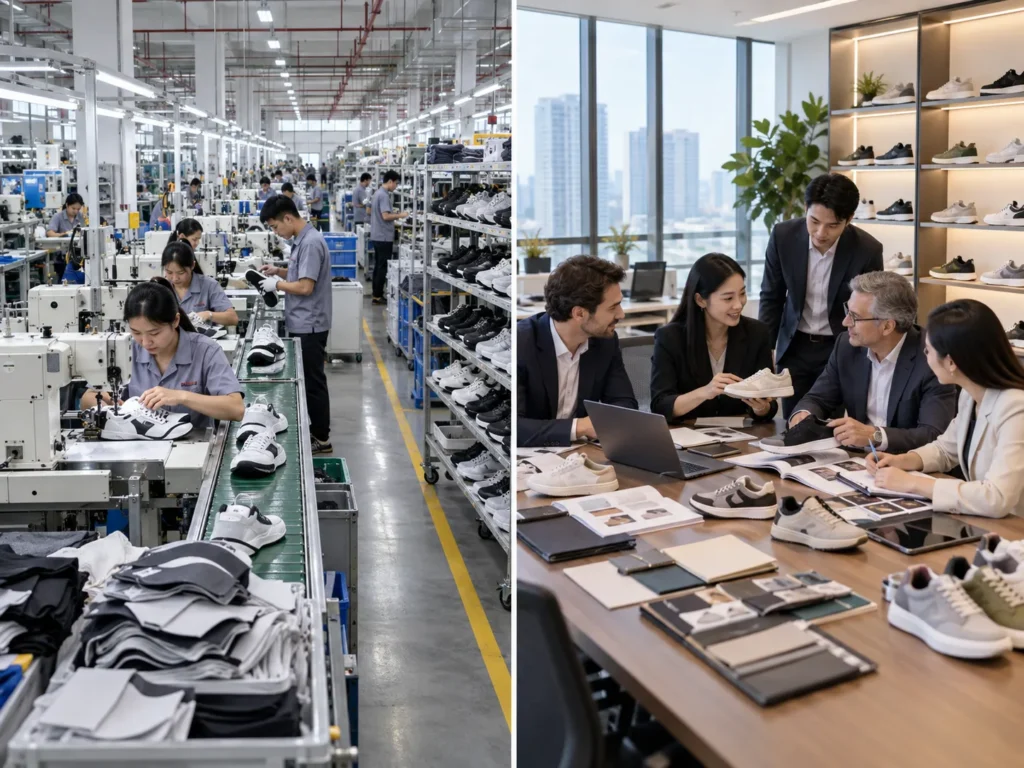
Deciding whether to partner directly with a shoe factory or through a trading company depends on your order volume, technical expertise, and internal management capabilities.
Strategic Evaluation: Weighing direct factory partnerships against trading companies requires balancing unit cost savings and direct engineering control against lower MOQs and multi-category sourcing flexibility.
📊 Evaluation Metric Comparison
| Evaluation Metric | Direct Shoe Factory | Footwear Trading Company |
|---|---|---|
| Unit Production Cost | Lowest (Direct factory gate cost) | Higher (Includes 10%–25% trading margin) |
| Minimum Order Quantity (MOQ) | High (500–1,200 pairs per style/color) | Low to Flexible (100–300 pairs per style) |
| Technical Communication | Direct with factory engineers & last makers | Intermediary sales agents (Risk of translation error) |
| Product Variety & Sourcing | Restricted to their specialized machinery/category | Unlimited (Sources across dozens of sub-factories) |
| Quality Control Management | Direct inline control at assembly stations | External inspections at packing stage |
| Custom Mold Tooling Support | High capability for custom R&D and molds | Limited (Relies on external factory mold shops) |
🚀 Advantages of Working Directly with a Shoe Factory
Working directly with a real factory delivers the lowest possible FOB costs and direct engineering collaboration. When technical challenges arise during shoe sample development—such as midsole delamination or heel slippage—communicating directly with the factory’s last-makers and bonding technicians results in faster, more effective solutions.
🤝 When a Trading Company May Be Useful
Trading companies offer value for start-up brands with low initial order volumes, complex multi-category product lines (e.g., ordering canvas sneakers, leather heels, and rubber boots in a single PO), or limited experience navigating Chinese supply chains. Trading companies aggregate orders across smaller factories, manage domestic logistics, and handle export documentation.
🔍 How to Tell the Difference
📦 Product Range
A factory typically focuses on 1-2 specialized shoe categories. A trading company offers an unrealistically broad catalog spanning safety boots, ballet flats, and technical cleats.
🏢 Factory Visits
Direct factories readily welcome onsite visits or unannounced third-party audits. Trading companies often stall, make excuses, or direct you to a third-party showroom.
💳 Tax & Payment Invoices
Check the bank account holder details for sample fees or deposits. Direct factories collect payments under their registered corporate entity name, matching their factory business license.
💡 Pro Tip on Partner Selection
Always request corporate verification documents and verify that banking details match the legal business name on the manufacturer’s official license before wiring any sample or production funds.
📨 Send the Manufacturer a Clear RFQ
A detailed Request for Quotation (RFQ) establishes professional credibility and forces suppliers to provide precise, structured pricing.
Strategic RFQ Insight: Providing a comprehensive RFQ eliminates vague pricing estimates, shortens sampling cycles, and demonstrates to manufacturers that you are an experienced footwear importer.
🖼️ Product Photos, Drawings or Tech Pack
Provide multi-angle 2D orthographic vector drawings (top, lateral, medial, outsole tread) or clear reference photos highlighting specific structural details, stitching lines, and material transitions.
🧵 Materials and Construction
Specify exact material classifications for every shoe component. Indicate upper material thickness (e.g., 1.2 mm action leather, 3D engineered polyester mesh), lining specs (e.g., 200g mesh with 4 mm foam backing), outsole compound (e.g., 60-degree Shore A rubber), and midsole construction (e.g., die-cut vs compression-molded EVA).
📏 Size Range and Colorways
Specify your required size breakdown (e.g., US Men’s 7–13, EU Women’s 36–41) and the number of colorways per style. Sizing ranges dictate last development costs, while colorway splits impact material dye-lot minimums.
📦 Order Quantity
Provide clear volume projections, breaking down quantities per style, per colorway, and across individual size distributions.
📦 Packaging Requirements
Detail packaging specifications, including inner tissue paper weight, shoe box dimensions, corrugated board strength (e.g., double-wall B-flute), silica gel desiccant packs, polybag specs, master carton packing ratios (e.g., 12 pairs per carton), and custom barcode labelling.
🛡️ Target Market and Testing Requirements
Inform the factory of your retail destination (e.g., USA, EU, Australia) to ensure compliance with regional chemical and physical regulations (e.g., EU REACH standards, California Proposition 65).
If slip resistance is important for the intended use of the shoe, the testing requirement should be defined before production. ASTM F2913-24 provides a laboratory method for measuring the dynamic coefficient of friction of whole footwear against test surfaces under reproducible conditions. Specifying the required test method at the RFQ and development stages helps the factory select outsole materials and constructions around a measurable performance requirement rather than addressing slip performance only after production.
💡 Standard Reference Note
Source: ASTM International, ASTM F2913-24. Refer to the official ASTM F2913-24 Standard Page for detailed testing protocols and laboratory friction coefficients.
⏱️ Expected Delivery Time
State your target production schedule, including required dates for initial fitting sample approval, pre-production (PP) sample sign-off, mass production completion, and FOB port delivery.
📋 Buyer RFQ Specification Template
| Parameter | Buyer Specification / Requirement |
|---|---|
| Footwear Style Name | Apex Runner Pro v1 |
| Construction Method | Cold Bonding / Cemented Construction |
| Upper Material | Engineered Polyester Mesh + 1.2mm TPU Hot-Melt Overlays |
| Lining Material | Breathable Mesh + 4mm Memory Foam Heel Collar |
| Midsole / Outsole | High-Rebound Molded EVA Midsole + 100% Natural Rubber Tread |
| Size Range & Ratio | US 7 to 13 (Standard US Mens Ratio 1:2:3:3:2:1) |
| Target Order Volume | 1,200 Pairs / Style (600 Pairs / Colorway) |
| Compliance Standards | EU REACH Compliant + ASTM F2913-24 Slip Resistance |
| Incoterms / Port | FOB Xiamen / Ningbo Port |
⚖️ Compare Shoe Manufacturers Beyond Price
Evaluating shoe manufacturing companies in china strictly on unit cost is a mistake that frequently leads to production delays, material substitutions, and quality failures.
Strategic Evaluation Insight: Assessing suppliers based on total capital exposure—including MOQs, tooling costs, and material integrity—ensures long-term profitability far beyond initial unit price quotes.
📦 MOQ (Minimum Order Quantity)
Compare minimum order requirements carefully. A factory offering $12.00 per pair with a 2,000-pair MOQ per colorway requires $24,000 in capital, whereas a factory offering $13.50 per pair at a 500-pair MOQ requires only $6,750, significantly reducing upfront inventory risk.
⚙️ Product Development Capability
Assess the sophistication of the supplier’s sample development room. Do they employ dedicated paper pattern masters, 3D last modeling software, and rapid prototyping sample lines?
💰 Sample Cost
Confirm standard sample creation fees. Factories typically charge 2x to 3x the standard FOB unit price to produce initial development prototypes, which is usually refunded or credited against mass production orders upon PO confirmation.
🛠️ Mold and Tooling Cost
If your design requires custom outsoles or TPU heel counters, evaluate mold tooling quotes. Outsole molds are typically priced per size set (ranging from $500 to $3,500 per size mold). Clarify mold ownership terms, usage lifespans, and maintenance responsibilities in writing.
🧵 Material Specifications
Ensure all quoted prices are evaluated against identical Bill of Materials (BOM) specs. A lower unit price often indicates that a supplier substituted genuine leather for synthetic PU, or swapped high-density rubber outsoles for cheap TPR compounds.
⏱️ Production Lead Time
Confirm standard production timelines:
- Development Sample Lead Time: 7–14 days.
- Outsole Mold Tooling Fabrication: 15–25 days.
- Mass Production Lead Time: 25–40 days after PP sample approval and deposit receipt.
🛡️ Quality Control
Inquire about inline quality control checkpoints during lasting, cementing, and stitching.
💡 Factory Production Experience Case Study
In August 2025, we were producing a 12,000-pair casual sneaker order with a rubber outsole when our inline bonding test found the peel-failure rate had increased from 1.8% to 6.4% during the first 1,500 pairs. We stopped the affected line and found that the outsole surface-treatment time had become inconsistent after a production shift change. We standardized the treatment time, added a process-record sheet at the cementing station, and tested one pair every 50 pairs for the next 2,000 pairs. The bonding failure rate fell to 0.9%. That project confirmed for us that controlling production parameters is more effective than relying only on final visual inspection.
💬 Communication and Technical Support
Assess the responsiveness and technical comprehension of the factory’s account management team. Effective project management requires bi-lingual merchandising staff who understand footwear terms (e.g., lasting margin, feather line, outsole bonding, vamp tension).
💳 Payment Terms
Standard B2B payment terms for footwear manufacturing in China are:
- Deposit: 30% T/T (Telegraphic Transfer) upon PO sign-off to initiate material purchasing.
- Balance: 70% T/T payable upon completion of final Pre-Shipment Inspection (PSI) before container loading.
Avoid payment arrangements requiring 100% upfront capital before sample sign-off.
📊 Evaluation Parameters Summary
| Evaluation Factor | Key Consideration | Recommended Benchmark |
|---|---|---|
| MOQ & Capital | Upfront financial exposure per SKU | Balance unit price vs. inventory risk |
| Tooling & Molds | Custom outsole mold expenses | Clarify ownership and lifespan in writing |
| Material Integrity | Identical BOM comparison | Prevent hidden material substitutions |
| Production Control | Inline checkpoints & parameter tracking | Active process control over visual inspection |
| Payment Security | Telegraphic Transfer structure | 30% deposit / 70% post-PSI balance |
📦 Order Samples Before Choosing a Manufacturer
Never commit to mass production without physically evaluating prototype samples built by the prospective factory.
Strategic Sampling Insight: Physical prototyping is the ultimate filter for validating both factory workmanship and material integrity before allocating large-scale manufacturing capital.
🔍 Start with a Development Sample
Request an initial paper-pattern and fitting sample (often called a “proto sample” or “upper pulled-over last”). The initial sample validates design lines, material drape, heel curvature, and overall visual silhouette.
🧵 Check Appearance and Workmanship
Inspect the sample carefully:
- Are stitching lines straight, parallel, and consistent (typically 7–8 stitches per inch)?
- Is there visible excess glue, adhesive smudging, or gaps along the outsole feather line?
- Are upper material panels cut cleanly without rough edges or uneven tension wrinkles?
📏 Check Fit and Measurements
Conduct thorough fitting trials on live wear-testers. Measure key dimensional parameters: ball circumference, instep height, toe-box clearance, and heel cup retention.
🛡️ Confirm Materials and Construction
Cross-reference every material layer against your Tech Pack BOM. Check lining breathability, insole density, eyelet durability, and lace tensile strength.
⚡ Test the Shoe in Real Use
Put the prototype through rigorous wear-testing, subjecting the shoe to real-world flex movement, outdoor running, or extended wear over 10–14 days. To streamline your full prototyping process, review our specialized Footwear Development Services guide.
For footwear where repeated flexing is a key durability concern, buyers can refer to ISO 24266:2020, Footwear — Test methods for whole shoe — Flexing durability. The standard specifies two methods for determining the flexing durability of complete footwear and was reviewed and confirmed by ISO in 2026. Using a recognized test method gives the buyer and manufacturer a measurable acceptance criterion instead of relying on subjective descriptions such as “the shoe feels durable.”
💡 Standard Reference Note
Source: International Organization for Standardization (ISO), ISO 24266:2020. Refer to ISO 24266:2020 – Footwear Flexing Durability for full laboratory testing protocols.
📋 Record Changes for the Next Sample
Compile all aesthetic, fitting, and structural modifications into a centralized Sample Feedback Comment Sheet (annotated with high-resolution photos). Transmit this report to the factory to guide creation of the secondary Pre-Production (PP) sample set.
📊 Sampling & Evaluation Checklist
| Evaluation Stage | Inspection Focus | Acceptance Benchmark |
|---|---|---|
| Proto Sample Review | Silhouette, drape, and pattern lines | Accurate alignment with Tech Pack drawings |
| Workmanship Audit | Stitch density & glue cleanliness | 7–8 stitches/inch, zero adhesive smudging |
| Fit & Dimension Test | Ball girth, instep, and toe clearance | Comfortable wear-tester feedback |
| Durability Standard | Flexing durability (ISO 24266:2020) | Measurable friction and flex resistance |
🏭 Visit or Audit the Factory Before a Large Order
Visiting the production facility prior to transferring substantial deposit funds mitigates financial and operational risk.
Strategic Audit Insight: On-site facility evaluations ensure that your prospective manufacturing partner possesses active operational management systems rather than just showroom facades.
📊 What the Nike Supply Chain Case Teaches Footwear Buyers
Nike’s supplier-management experience shows why factory selection should go beyond certificates and one-time audits. Research published by Harvard Kennedy School analyzed audit data from more than 800 Nike supplier factories across 51 countries and found that monitoring alone produced limited improvements in working conditions. More meaningful improvements occurred when supplier monitoring was combined with operational changes such as better production scheduling, quality management, and manufacturing efficiency. For footwear buyers, the lesson is practical: a factory audit should not only confirm that a facility exists and meets basic requirements; it should also evaluate whether the supplier has the management systems needed to control production consistently and correct problems when they occur.
Nike’s broader supplier-management strategy also evolved significantly after labor-condition controversies involving Asian suppliers in the 1990s, moving toward stronger supplier incentives, greater transparency, and systems designed to prevent problems rather than simply identify them after they occurred.
💡 Academic & Case Study Sources
Sources: Harvard Kennedy School, Does Monitoring Improve Labor Standards? Lessons from Nike; Stanford Graduate School of Business, Nike’s Strategy to Improve Conditions in its Global Supply Chain – A Case Study. Harvard Kennedy School Report | Stanford GSB Case Study.
🔍 Factory Audit Inspection Checkpoints
⚙️ Check the Development Department
Inspect the sample development room. Ensure they maintain calibrated last-turning machines, computerized pattern-cutting tables, and organized material swatch archives.
🏗️ Check Production Lines
Walk the main assembly floor. Observe active lasting lines, automatic cementing application stations, heat-activation drying tunnels, and chilling units. Verify that lines run with structured step-by-step workflow discipline.
📦 Check Material Storage
Inspect raw material warehouses. Confirm that leather hides are stored flat in climate-controlled spaces, chemical adhesives are dated and sealed, and synthetic rolls are stored off the ground away from direct humidity.
🛡️ Check Quality Control
Review internal quality testing equipment. Check if the factory operates on-site physical test labs equipped with outsole flexing testers, upper leather tensile strength machines, crock meters (rubbing colorfastness), and bonding peel strength testers.
📋 Check Current Production
Examine current production runs active on the assembly line. Inspect the finishing quality of shoes currently being boxed for other international clients to evaluate baseline workmanship standards.
🤝 Confirm Whether Subcontracting Is Used
Explicitly confirm that all lasting, stitching, and assembly processes for your order will occur inside this audited plant location rather than being illegally subcontracted out to unverified rural workshops during peak seasons.
📊 On-Site Audit Verification Summary
| Audit Station | Key Evaluation Target | Acceptance Benchmark |
|---|---|---|
| Development Room | Last-turning & CAD pattern equipment | Calibrated tools & organized pattern archives |
| Assembly Floor | Lasting lines & cementing tunnels | Structured workflow discipline |
| Material Warehouse | Leather hide & chemical storage | Climate-controlled & properly dated inventory |
| Testing Laboratory | Flex, tensile, & peel strength testers | Fully functional on-site physical test labs |
| Subcontracting Policy | Internal vs. external production lines | 100% in-plant manufacturing guarantee |
🚀 Start with a Trial Order
Initiating your business relationship with a manageable trial production batch reduces supply chain exposure while testing supplier performance under real operational conditions.
Strategic Staging Insight: Trial production staging provides a structured roadmap from initial sample sign-off to final container delivery, ensuring complete quality oversight at every manufacturing milestone.
💡 Why a Trial Order Reduces Risk
A trial order (e.g., 500 to 1,000 pairs total) tests the supplier’s actual manufacturing discipline, material procurement timelines, packaging execution, and communication transparency under real production pressure without over-committing working capital.
📋 Confirm a Pre-Production Sample
Before authorizing mass cutting, demand a final Pre-Production (PP) sample produced directly on the mass assembly line using actual production materials and tooling. Once approved, this sample becomes the “Golden Sample” benchmark used for quality control inspections.
🔍 Monitor Production Quality
Schedule During Production Inspections (DPI) when 20% to 30% of the trial order has passed down the assembly line. Inline inspections detect root-cause bonding, lasting, or stitching defects early enough to adjust assembly parameters before the entire order is produced.
📦 Inspect the Finished Order Before Shipment
Hire an accredited third-party inspection agency (e.g., QIMA, SGS, AsiaInspection) to conduct a formal Pre-Shipment Inspection (PSI) when 100% of the order is manufactured and at least 80% is packed into master cartons. Utilize ISO 2859-1 (ANSI/ASQ Z1.4) Acceptable Quality Limit (AQL) statistical sampling protocols (typically AQL 0 Critical, 2.5 Major, 4.0 Minor defects).
📊 Review the Supplier After Delivery
Upon receiving the container at your destination warehouse, audit physical box counts, carton integrity, packaging compliance, and perform spot fitting checks. Document defect rates and evaluate supplier performance across four key metrics: On-Time Delivery Rate, Defect Percentage, Communication Responsiveness, and Invoice Accuracy.
📊 Trial Production Staging Summary
| Production Stage | Action / Milestone | Quality Control Benchmark |
|---|---|---|
| Pre-Production | PP Sample Sign-Off | Golden Sample sealed for comparison |
| Inline Inspection | DPI at 20%–30% completion | Verify Lasting, Cementing & Stitching |
| Final Inspection | PSI at 100% production & 80% packing | AQL 2.5 Standard (Major: 2.5, Minor: 4.0) |
| Post-Delivery | Performance & Defect Audit | Assess Defect Rate & On-Time Delivery |
⚠️ Common Red Flags When Choosing a Shoe Manufacturer
Identifying operational warning signs early protects footwear brands from severe inventory loss and supply disruptions. Avoid costly sourcing traps by studying our comprehensive Footwear Sourcing Pitfalls Guide.
Strategic Warning Insight: Recognizing early red flags in supplier quotes and communications prevents catastrophic quality failures and financial loss before production begins.
🏷️ Extremely Low Prices
Quoted unit prices that fall 20% to 30% below regional industry averages signal hidden operational traps—such as substituting inferior material grades, omitting mid-sole cushioning, employing unbonded adhesives, or utilizing unauthorized sub-tier workshops.
👟 Claims to Manufacture Every Type of Shoe
Be cautious of suppliers claiming equal expertise across technical running shoes, Goodyear-welted dress boots, vulcanized sneakers, and injection-molded clogs. Genuine manufacturers specialize within distinct construction boundaries.
💬 Cannot Clearly Explain Production Processes
If an account representative stumbles when asked specific technical questions—such as defining midsole EVA hardness (Shore C rating), last heel pitch adjustments, or outsole vulcanization pressure—they are likely an inexperienced middleman.
🏢 Avoids Showing the Factory
A persistent refusal to host live video walkthroughs, provide exact factory addresses, or accommodate independent third-party audits strongly indicates that the supplier is an unauthorized broker.
🧵 Unclear Material Specifications
Beware of vague material quotes such as “high-quality leather” or “premium mesh.” Professional manufacturers detail exact chemical, weight, and thickness standards (e.g., “1.4mm full-grain cowhide leather with water-repellent coating”).
⏱️ Unrealistic Lead Times
Promises to develop custom tooling molds and complete mass production of 10,000 pairs within 15 days are commercially impossible in footwear manufacturing. Realistic lead times require 30–45 days for mold fabrication and 45–60 days for production assembly.
🔄 Poor Technical Communication
If a supplier repeatedly fails to grasp fundamental technical corrections documented in your Sample Comment Sheets during initial prototyping, communication breakdown will multiply during mass production.
💰 Unclear Mold or Development Costs
Unclear quotes regarding mold ownership rights, modification fees, or sample refund structures lead to financial disputes once custom outsole tooling is completed.
📊 Sourcing Red Flag Risk Assessment Summary
| Warning Sign | Potential Root Cause | Recommended Action |
|---|---|---|
| Abnormally Low Prices | Material substitution or unbonded adhesives | Demand identical BOM specification quote |
| Universal Product Claims | Trading company acting as broker | Verify factory specialization boundaries |
| Evasive Factory Access | Hidden sub-tier workshop utilization | Require live video walkthrough or audit |
| Unrealistic Lead Times | Lack of realistic production scheduling | Enforce 45–60 day production standard |
🗺️ A Simple Process for Finding a Shoe Manufacturer in China
Follow this sequential 10-step roadmap to establish a reliable, high-performing footwear manufacturing partnership in China:
Roadmap Overview: Executing a structured 10-step selection framework mitigates early-stage operational risks, secures transparent pricing, and protects long-term inventory quality.
📝 Step 1 — Define Your Product
Prepare a complete footwear Tech Pack containing orthographic vector drawings, detailed BOM specs, pantone references, size ranges, target FOB costs, and required compliance standards.
🌐 Step 2 — Build a Supplier List
Gather an initial pipeline of 20 to 30 candidate suppliers utilizing targeted Google search queries, B2B directories (Alibaba/Global Sources), Jinjiang/Canton Fair exhibitor catalogs, and regional cluster mapping.
🎯 Step 3 — Shortlist Suitable Factories
Filter your initial pipeline down to 3–5 candidate factories based on product category alignment, manufacturing line capabilities, material expertise, and geographic regional hub specialization.
🛡️ Step 4 — Verify Manufacturing Capability
Validate business licenses, 18-digit Unified Social Credit Codes, factory business scopes, live video assembly floor walkthroughs, and valid third-party social compliance audits (BSCI/SMETA/ISO).
📨 Step 5 — Send RFQs
Issue standardized RFQ document packages detailing exact BOM specs, size breakdowns, target order volumes, packaging requirements, and required international testing criteria (e.g., ASTM F2913-24).
⚖️ Step 6 — Compare Suppliers
Analyze supplier proposals using a holistic scoring matrix that accounts for unit FOB cost, sample turnaround speed, custom mold tooling expenses, payment terms, and technical communication quality.
📦 Step 7 — Develop Samples
Commission proto fitting samples and secondary Pre-Production (PP) sets. Perform rigorous laboratory, dimensional, and real-world wear testing (referencing ISO 24266:2020 flexing standards).
🏭 Step 8 — Audit the Factory
Conduct an on-site physical factory audit or hire a certified third-party inspection firm to audit the supplier’s development rooms, raw material storage, active lasting lines, and internal QA testing labs.
🚀 Step 9 — Place a Trial Order
Issue a controlled initial Purchase Order (e.g., 500 to 1,000 pairs). Establish 30/70 payment terms, seal an official Pre-Production Golden Sample, and schedule inline (DPI) and pre-shipment (PSI) inspections under AQL 2.5 standards.
📈 Step 10 — Move to Mass Production
Upon successful completion, receipt, and warehouse review of the trial production run, establish long-term vendor KPIs, secure annual material dye-lot pricing, and transition to recurring full-scale mass production orders.
📊 10-Step Manufacturer Selection Summary
| Roadmap Stage | Key Action Item | Core Objective |
|---|---|---|
| Steps 1–3 | Define, Build, & Shortlist | Establish Tech Pack and identify 3–5 candidate factories |
| Steps 4–6 | Verify, RFQ, & Compare | Validate credentials, issue RFQs, and score proposals |
| Steps 7–8 | Develop Samples & Audit | Test prototypes (ISO 24266) and conduct site audits |
| Steps 9–10 | Trial Order & Scale | Execute trial batch (AQL 2.5) and transition to mass production |
📋 Shoe Manufacturer Selection Checklist
Utilize this practical evaluation matrix to score prospective footwear factories during your shortlisting phase:
Strategic Checklist Insight: Scoring prospective factories systematically across operational categories ensures that your final manufacturing partner meets both technical specifications and commercial requirements.
📊 Evaluation Matrix Summary
| Evaluation Category | Audit / Verification Requirement | Compliance Status (Pass/Fail) |
|---|---|---|
| Product Category Fit | Factory’s core output matches your specific shoe construction (e.g. >70% volume) | [ ] Pass / [ ] Fail |
| Manufacturing Capability | Operates required in-house machinery (toe-lasting, cementing, pressers, drying tunnels) | [ ] Pass / [ ] Fail |
| Development Capability | Maintains in-house paper pattern makers, last-turning assets, and dedicated sample room | [ ] Pass / [ ] Fail |
| MOQ and Pricing | Minimum order requirements and unit FOB pricing align with target commercial budget | [ ] Pass / [ ] Fail |
| Quality Control | Possesses internal physical lab (flexing, crocking, bonding peel strength testers) | [ ] Pass / [ ] Fail |
| Lead Time and Capacity | Available line capacity supports 45-60 day production turnarounds without subcontracting | [ ] Pass / [ ] Fail |
| Communication & Support | Dedicated English-speaking merchandising team with deep technical footwear knowledge | [ ] Pass / [ ] Fail |
🎯 Detailed Evaluation Breakdown
👟 Product Category Fit
Confirm the factory regularly manufactures your exact footwear style and construction method as part of their standard daily operations.
⚙️ Manufacturing Capability
Verify that the factory owns, operates, and maintains essential assembly, lasting, stitching, and sole bonding equipment directly on site.
📐 Development Capability
Ensure the supplier maintains an active, sophisticated sample creation room capable of translating vector Tech Packs into accurate fitting prototypes.
💰 MOQ and Pricing
Validate that initial minimum order volumes, custom mold tooling costs, and unit FOB prices provide sustainable retail profit margins.
🛡️ Quality Control
Confirm that systematic quality management systems and inline inspection checks are enforced at every step of assembly.
⏱️ Lead Time and Capacity
Ensure the facility holds sufficient open line capacity to execute your production order within agreed delivery windows.
💬 Communication and Support
Confirm that factory account managers maintain fast, clear, and technically accurate communication channels throughout design and production.
💡 Pro Tip on Checklist Implementation
Assign weighted scores to each category based on your brand’s specific operational priorities before evaluating your shortlist of footwear manufacturing partners.
❓ Frequently Asked Questions
Explore key insights regarding footwear manufacturing, sourcing regions, MOQs, pricing structures, verification protocols, and custom development strategies in China.
Strategic FAQ Insight: Understanding regional specializations, MOQs, and verification methods streamlines the supplier selection process and minimizes early-stage supply chain risk.
🌐 Where Can I Find Shoe Manufacturers in China?
Where can I find a wholesale shoe manufacturer in China? You can find wholesale shoe manufacturers in China by using targeted digital search queries on Google, searching verified supplier databases on B2B portals like Alibaba and Global Sources, attending major trade exhibitions such as the Jinjiang Footwear Expo or Canton Fair, or engaging a localized footwear sourcing agent in Jinjiang or Dongguan.
🏭 What Is the Best Shoe Manufacturing Region in China?
The best manufacturing region depends on your specific footwear category. Fujian (Jinjiang/Quanzhou) is the premier regional hub for performance athletic footwear and sneakers. Guangdong (Dongguan/Guangzhou) excels in high-end leather fashion shoes, heels, and complex boots. Zhejiang (Wenzhou/Taizhou) is ideal for mass-market synthetic shoes, vulcanized canvas footwear, and safety work boots.
📦 What Is the Typical MOQ for Chinese Shoe Manufacturers?
Standard Minimum Order Quantities (MOQs) for direct footwear factories in China typically range from 500 to 1,200 pairs per style, with sub-MOQs of 250 to 300 pairs per colorway. Trading companies or smaller specialized factories may accept lower trial volumes of 100 to 300 pairs per style at slightly higher unit FOB costs.
🛡️ How Do I Know If a Chinese Shoe Supplier Is a Real Factory?
To verify if a supplier is a direct factory, inspect their official Chinese Business License to confirm that their registered business scope includes “Manufacturing” or “Production.” Request live video walkthroughs of the operating lasting and stitching lines, verify third-party audit reports (BSCI, ISO 9001), and ensure their corporate bank account details match their registered factory name.
💰 How Much Does It Cost to Manufacture Shoes in China?
How much does it cost to manufacture shoes in China? Manufacturing costs vary widely based on materials, construction, and order volume. Basic vulcanized canvas sneakers or synthetic casual shoes typically range from $4.00 to $9.00 FOB per pair. Technical athletic running shoes with compression EVA midsoles range from $11.00 to $22.00 per pair. Premium full-grain leather boots or Goodyear-welted footwear cost $28.00 to $55.00+ FOB per pair. Custom outsole mold tooling sets add $1,500 to $3,500 per size mold.
📐 Can Chinese Factories Manufacture Shoes from My Own Design?
Yes, direct OEM shoe manufacturers in China regularly produce custom footwear derived from original customer designs. To execute custom production, buyers must supply a detailed Tech Pack containing orthographic vector drawings, complete Bill of Materials (BOM) specifications, pantone color codes, and size ranges. Custom designs require initial last creation and dedicated outsole mold tooling.
🔍 Should I Visit the Factory Before Placing an Order?
While not strictly mandatory for small trial orders, visiting the factory in person or commissioning an accredited third-party agency to perform a formal pre-production facility audit is highly recommended before committing substantial deposit capital. Onsite visits confirm physical plant existence, equipment sophistication, working conditions, and operational capacity.
⚖️ How Many Shoe Manufacturers Should I Compare?
It is best practice to initiate contact with 15 to 20 potential footwear suppliers during initial research. Filter this list down to 3 to 5 candidate factories for formal RFQ quotation and detailed technical comparison, and select 2 final qualified suppliers to construct prototype development samples before awarding final mass production contracts.
📊 FAQ Quick Reference Matrix
| Category | Key Subject | Standard Industry Benchmark |
|---|---|---|
| Geography | Regional Specialization | Fujian (Sneakers), Guangdong (Leather), Zhejiang (Canvas/Safety) |
| Volume | Minimum Order Quantities | 500–1,200 pairs per style (100–300 per colorway) |
| Pricing | FOB Unit Cost Range | $4.00 to $55.00+ depending on construction complexity |
| Verification | Factory License Scope | Must include “Manufacturing” or “Production” |