
How much does it cost to make a shoe? For a brand working with a factory, the honest answer comes in two parts: a set of one-off costs you pay before production — development, samples and sometimes an outsole mold — and a per-pair factory price for every shoe in the order. Most first budgets go wrong on the first part, not the second.
This guide breaks both halves down the way a factory costs them: what you pay for samples and tooling, how a per-pair price is built from materials, labour and overhead, how order quantity, branding, testing, freight and duties move the number, and how to cut cost without cutting quality. Where we quote figures, they are our own current terms at SeeU Shoe; where we quote industry data, the source is linked.
💡Quick answer
💰How Much Does It Cost to Make a Shoe? The Short Answer
The cost to make a shoe is the factory’s per-pair price plus your share of the one-off costs, spread over the pairs you order. A simple shoe on an existing sole in a reasonable quantity has a low per-pair price and almost no one-off cost. A new design on a private outsole mold, in several colorways and a small first order, carries more one-off cost per pair — even if the shoe itself is no more expensive to build.
◆Where Each Shoe Category Sits on Price
The table shows where the four categories we manufacture usually sit relative to each other on per-pair FOB price, and what moves a style up or down inside its category. Because two shoes in the same category can differ several-fold in materials and construction, we quote each style on its specification rather than from a fixed price list.
Casual Shoes and Sneakers
Casual sneakers span the widest price range of any category because the same silhouette can be built in canvas on a vulcanized sole or in full-grain leather on a stitched cupsole. If you are planning a range, our page on casual shoe and sneaker manufacturing shows the constructions we run.
Outdoor, Hiking and Barefoot Shoes
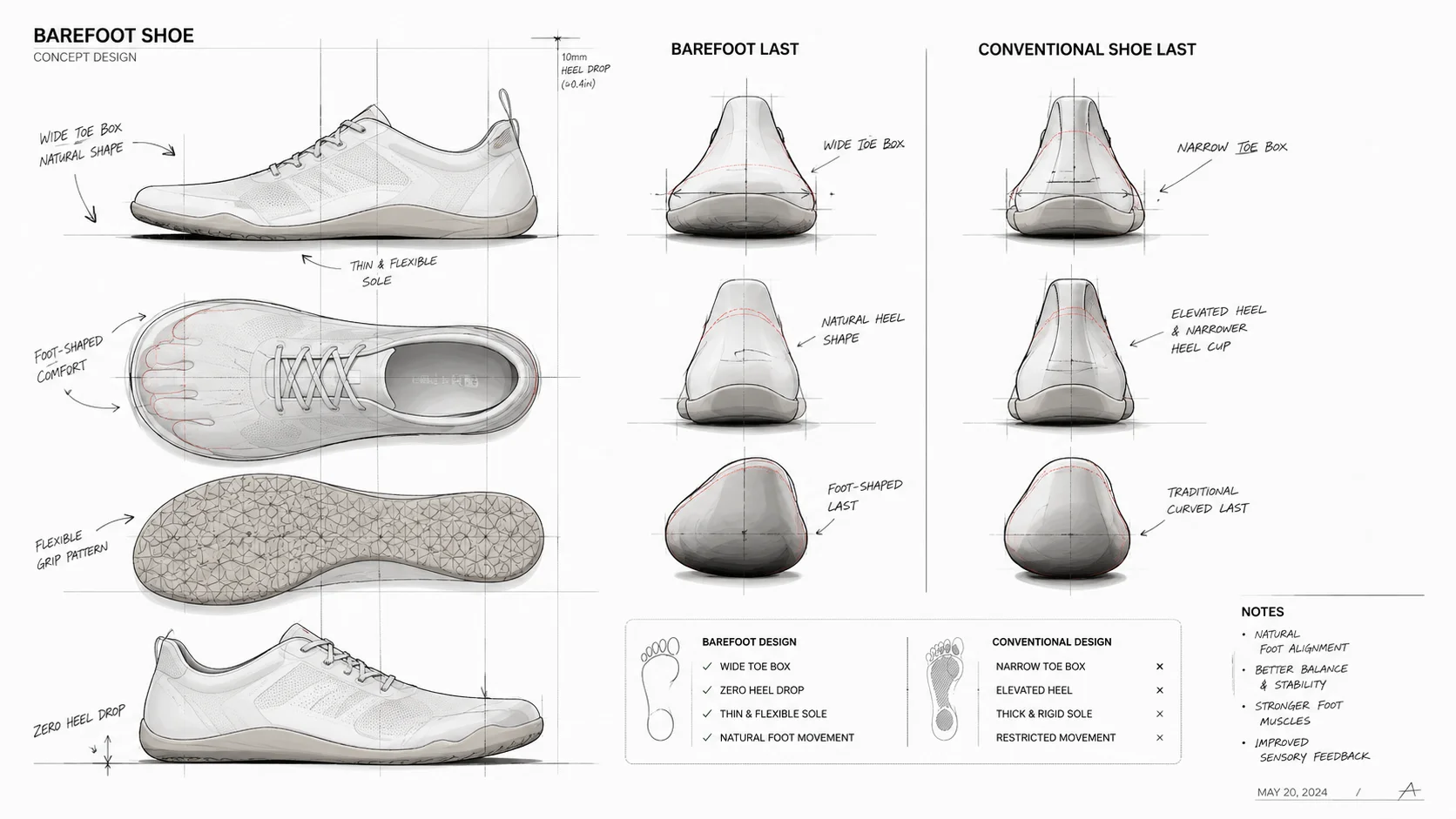
Outdoor shoes cost more to make mainly because of the sole: a durable rubber outsole with deep lugs uses more compound, and toe caps, heel counters and overlays add pattern pieces and stitching. See the hiking, trail and barefoot shoes we make.
Comfort Slippers
Slippers have fewer components and simpler construction, so their per-pair price sits at the low end — but wool felt, shearling-style linings and molded TPU soles can lift a premium slipper well above a basic one. See our comfort slipper range.
Medical and Senior Wide-Fit Shoes
Wide-fit and extra-depth shoes need a dedicated last, more upper material and closures that open wide, such as hook-and-loop straps or D-rings. Those details add cost per pair; the orthopedic and wide-fit shoes page explains the options.
◆What an FOB Price Includes — and What It Doesn’t
FOB (Free On Board) means the factory’s price covers the shoe, its packaging and delivery onto the vessel at the named port of export. If you want to buy shoes direct from manufacturers, FOB is the price you will usually be quoted. It normally includes:
- All materials and components, labour, factory overhead and the factory’s margin
- The retail box, labels and inner packing you specified, plus the export carton
- Inland transport to the port and export customs clearance in China
It does not include ocean or air freight, insurance, import duty, customs brokerage and port charges in your country, or delivery to your warehouse. Those are covered in the landed-cost section below. The port of export is named in every quote we send, so you can book freight from the right place.
◆Why Two Quotes for the “Same” Shoe Can Differ by 2×
Buyers often send the same reference photo to several factories and receive prices that are far apart. The gap is rarely about one factory being greedy; it is usually about three hidden assumptions.
Different Materials Behind the Same Photo
A photo cannot show leather grade, foam density or rubber compound. One factory may quote split leather and a TPR sole; another quotes full-grain leather and a rubber sole. Both shoes look the same in a picture and feel completely different in hand.
Different Construction Methods
The same sneaker can be cemented, built on a stitched cupsole or vulcanized. Each method uses different equipment, labour time and sole tooling, so each produces a different price.
Different Quantity Assumptions
A quote for 500 pairs and a quote for 5,000 pairs are different quotes. If one factory has priced a larger run and another has priced your actual first order, the comparison is meaningless until the quantity is the same.
⚖️One-Off Costs vs Per-Pair Costs: The Two Halves of a Shoe Budget
Every answer to how much does it cost to make a shoe splits into money you spend once per style and money you spend on every pair. Keeping the two apart makes quotes easier to compare and first-order cash needs easier to plan.
◆One-Off Costs: Development, Samples and Tooling
One-off costs are paid before or at the start of a project: design and tech pack work, a custom last if you need one, sample rounds, and tooling such as a private outsole mold, logo molds or cutting dies. They do not grow with order size, which is why they weigh heavily on small first orders and almost disappear on repeat orders.
◆Per-Pair Costs: Materials, Labor, Overhead and Packaging
Per-pair costs are built into the FOB price: upper and lining materials, the sole unit, components such as laces and eyelets, labour across cutting, stitching, lasting and finishing, factory overhead and margin, and packaging. These scale directly with the number of pairs.
◆Which Costs Are Credited Back Against Bulk Orders
At SeeU Shoe, sample fees for shoes built on an existing last and public mold are credited back against your bulk order once it is placed. A private outsole mold is not credited, because it becomes your brand’s property and can be used for every future order. Ask any factory you work with to put its credit rules in writing before you pay for samples.
✏️Development Costs: Design, Tech Pack, Lasts and Patterns
Development turns an idea into instructions a factory can build. If you are working out how much does it cost to make a shoe from scratch, this is the first line of the budget, and how much you pay here depends mostly on how complete your starting point is.
◆Design Drawings and the Tech Pack
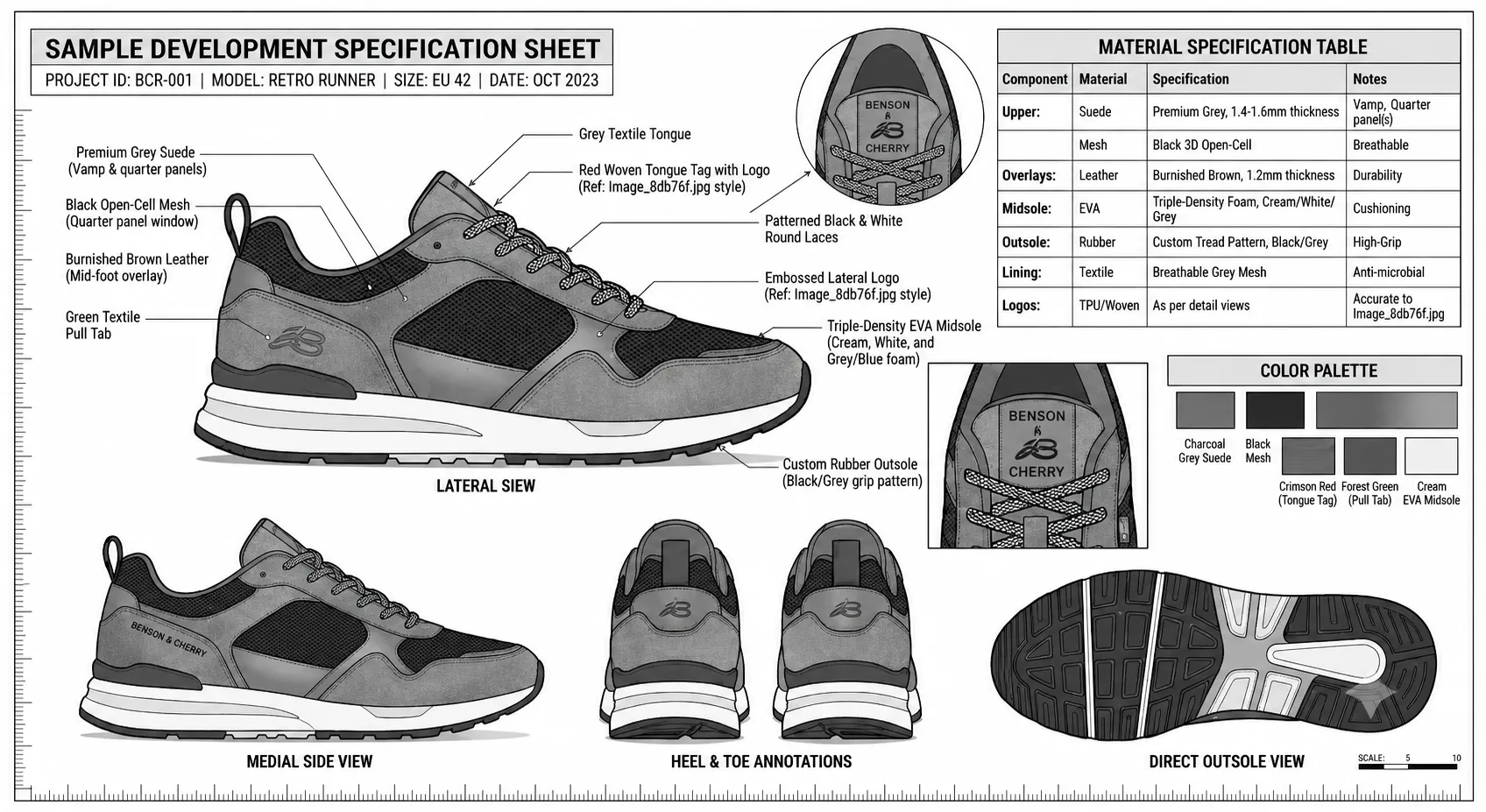
A tech pack is the shoe’s specification: side and top views, materials and colors for each part, measurements, logo placements, sole reference and packaging. The more of it you supply, the less the factory has to guess — and every guess is a potential extra sample round.
Starting From a Sketch or Reference Shoe
Many brands start with a sketch or a shoe they like. A factory development team can work from that, translating it into patterns and a material list, but expect at least one extra sample round while the details are agreed.
What a Complete Tech Pack Saves You
A complete tech pack shortens development because material, color and measurement questions are answered before the first sample is cut. It also makes quotes from different factories comparable, because everyone is pricing the same specification.
◆Using an Existing Last vs Developing a Custom Last
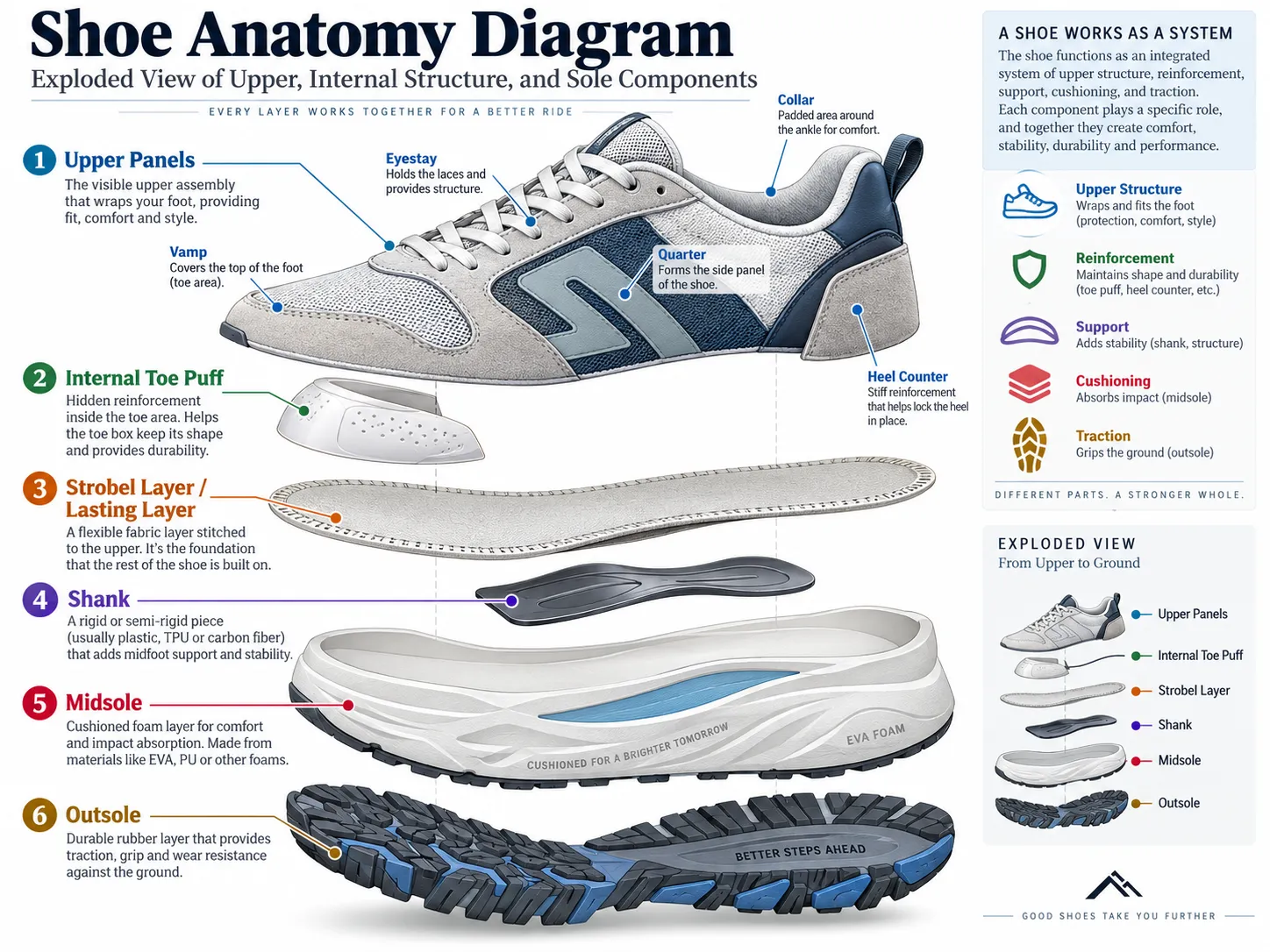
The last is the foot-shaped form a shoe is built around, and it decides fit, toe shape and volume. If you are not sure what that involves, read our guide to the shoe last. Using a last the factory already has costs nothing extra and keeps sampling fast. Developing a new last adds time and cost because it must be shaped, approved and then produced across your full size range.
◆Pattern Making and Size Grading
Once the design and last are fixed, the upper is broken into flat pattern pieces and graded into every size. Each extra piece adds cutting and stitching work in production, so pattern decisions made in development affect the per-pair price for the life of the style.
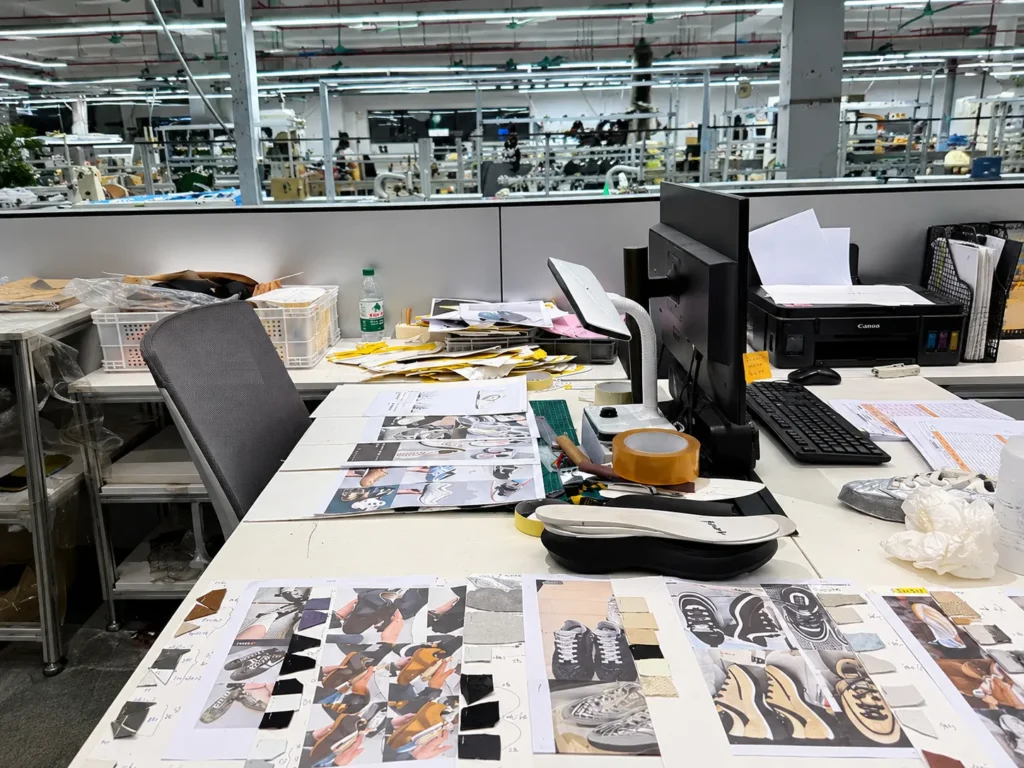
Our product development and sample workshop in Quanzhou — where development and sample costs are spent.
👟Sample Costs: What You Pay Before Bulk Production
Samples are where a design becomes a real shoe you can wear, measure and photograph. They are also the one-off cost brands most often underestimate, because a project rarely needs just one sample. Our shoe sample and prototyping process page walks through each round in detail.
◆The Sample Stages Brands Pay For
Prototype Sample
The first shoe built from your design. It confirms the overall look and construction; materials may be close substitutes rather than final.
Revision and Fit Samples
Corrected samples after you review the prototype — adjusting fit, proportions, materials or details. Most of the variation in sample budgets comes from how many of these rounds a project needs.
Size Set (Size Run) Samples
Samples in several sizes, built to check that grading works across the range, not just in the sample size.
Pre-Production (PP) Sample
The final sample in production materials, made the way bulk will be made. Once you approve it, it becomes the reference every bulk pair is checked against.
◆How Sample Fees Are Calculated
Sample fees cover materials and the hand labour of building shoes one or two pairs at a time, which is far slower than production. At SeeU Shoe, samples built on an existing last and public mold start from US$28 per pair, can be ordered from a single pair and are ready in 3–7 days. Samples that need a new last or a private sole take longer, because the tooling has to be made first.
🏭From our sample room
The cheapest sample round is the one you don’t need. When a brand sends a reference shoe plus a written list of what must change — toe shape, collar height, material, colors — the first sample usually lands much closer than when we work from photos alone.
For EVA soles we also time our measurements: EVA keeps shrinking slightly after it leaves the mold, so a sole measured straight away can read out of spec while the same sole measured after it stabilises is within tolerance. Measuring at the right time avoids paying for a “correction” round that wasn’t needed.
◆How Many Sample Rounds to Budget For
A simple update to an existing style may need one round plus a PP sample. A new design on a new last should be budgeted for two or three rounds before the PP sample. Shipping samples to you by express courier is a separate cost and adds up with each round.
◆How to Keep Sampling Costs Under Control
- Start on an existing last and public mold, then switch to private tooling once the design is proven.
- Send a physical reference shoe whenever you can.
- Review each sample against a written checklist and send all comments in one message.
- Combine colorway approvals with material swatches rather than full extra samples.
🛠️Tooling Costs: Outsole Molds and Other Tools
Tooling is the biggest single one-off cost in most footwear projects — and the one with the most room to plan around.
◆Public Molds: No Tooling Cost
Public molds are outsole molds the factory already owns and lets any client use. We hold more than 800 of them. Building on a public mold means no mold fee and faster samples.
What You Can and Cannot Change on a Public Mold
You can usually choose the sole color, the material compound and sometimes add a logo where the mold allows. You cannot change the sole shape, tread pattern or sidewall design, and other brands may use the same sole.
◆Private Molds: An Investment Your Brand Owns
A private mold is made for your brand alone, with your sole shape, tread and logo. Brands usually move to one when a style is proven or when the sole is part of their identity. Our guide to the shoe outsole explains sole types and how public and private molds compare.
Mold Cost and Lead Time
At SeeU Shoe a private outsole mold starts from US$700 and takes 7–15 days to make. The final price depends on the sole’s size and complexity, the material and the size range. A sneaker mold for a multi-material sole costs more than a single-material flat sole.
Why Molds Are Priced by Size
An outsole mold is cut for each size the sole comes in, so a sole offered in ten sizes needs ten mold cavities or mold sets. That is why a narrow size range — or sizes that share one sole — lowers tooling cost.
Who Owns the Mold, and How to Put It in Writing
If you pay for a private mold, agree in writing that it belongs to your brand, that it will be used only for your orders, and what happens to it if you move production. A short clause in your purchase agreement prevents most disputes.

Sole injection molding — the stage where outsole mold costs come in.
◆Other Tools: Cutting Dies, Logo Molds and Heel Molds
- Cutting dies — steel dies that cut upper pieces quickly in production.
- Logo molds — small molds for rubber or TPU badges, debossed insoles or molded heel logos.
- Heel or cupsole molds — needed when a heel unit or cupsole is unique to your design.
Ask for these to be listed separately in your quote so they don’t hide inside the per-pair price.
🧾Shoe Costing: How the Per-Pair Price Is Built
A factory’s per-pair price is built bottom-up on a costing sheet. Learning to read one is the fastest way to understand shoe manufacturing cost and where you have room to negotiate.
◆What Goes Into a Shoe Costing Sheet
Upper Materials and Linings
Each material is costed by the amount used per pair, including cutting waste. Leather is bought by area and has natural defects, so it usually carries more waste than synthetics.
Sole Unit
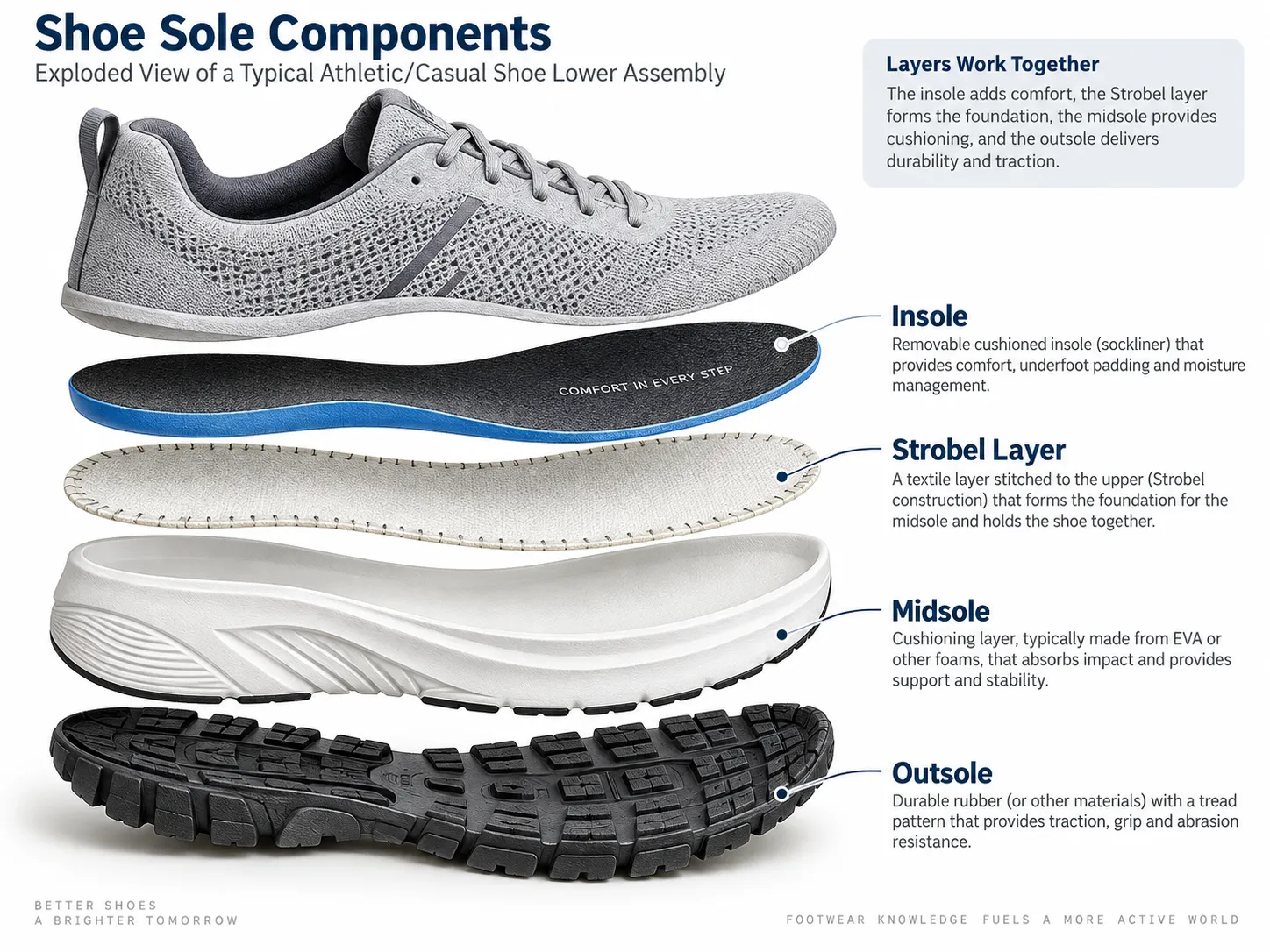
The outsole, midsole and any heel unit, priced by material and weight. On outdoor shoes the sole can be the single largest material cost.
Components and Trims
Laces, eyelets, zips, buckles, hook-and-loop, toe puffs, heel counters, insoles, threads and adhesives.
Labor
The time to cut, stitch, last, attach the sole, finish and inspect. More pattern pieces and stitching rows mean more labour minutes per pair.
Overhead and Factory Margin
Machinery, energy, quality control, management and the factory’s profit, usually applied as a share of material and labour cost.
◆Typical Share of Materials, Labor and Overhead
For most of the shoes we make, materials — upper, lining and sole — are the largest share of the FOB price, followed by labour, then overhead and margin. The split shifts with the shoe: a leather shoe on a rubber sole is heavily weighted towards materials, while a shoe with many stitched panels carries a larger labour share. Ask for a costing breakdown with your quote to see the split for your own style.
◆How to Read a Factory Costing Breakdown
Check that every material line names a specific material and thickness, that the sole is described by material and construction, that packaging matches your specification, and that tooling is listed separately. A breakdown that only shows totals gives you nothing to compare.
🧵How Materials Change the Cost of a Shoe
Materials are where the biggest price differences between similar-looking shoes come from.
◆Upper Materials
Full-Grain Leather and Suede
Premium look and durability, but higher cost per square foot plus cutting waste around natural marks. Leather grade can move the price of an otherwise identical shoe significantly.
Microfiber and Synthetic Leather
More consistent and lower waste than leather, with a wide range of quality. Good microfiber can get close to leather’s look at a lower cost.
Mesh, Knit and Canvas
Generally low-cost and light. Engineered knit uppers need specialised knitting and can cost more than a basic mesh.
Wool Felt and Recycled Materials
Common on slippers and comfort shoes. Wool content, felt thickness and certified recycled content all raise material cost compared with standard synthetics.
◆Sole Materials: Rubber, EVA, TPR, TPU and PU
◆Linings, Insoles and Trims
Leather linings, memory-foam comfort insoles, branded laces and metal hardware all add cost per pair. They are also where a shoe feels premium, so choose them deliberately.
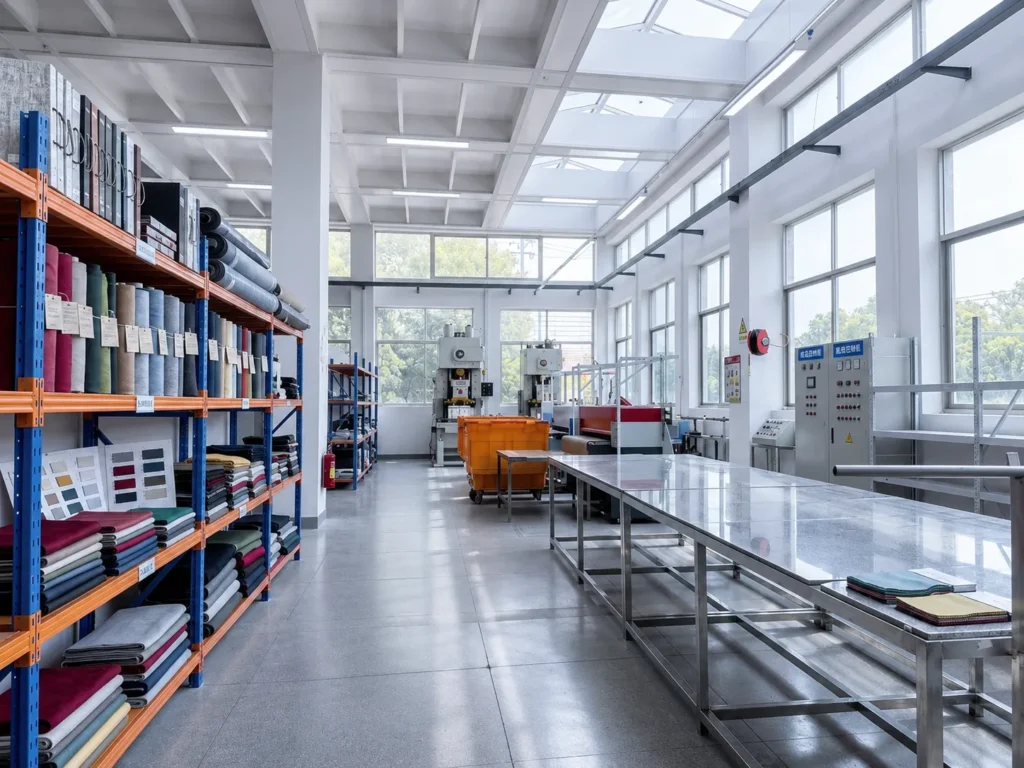
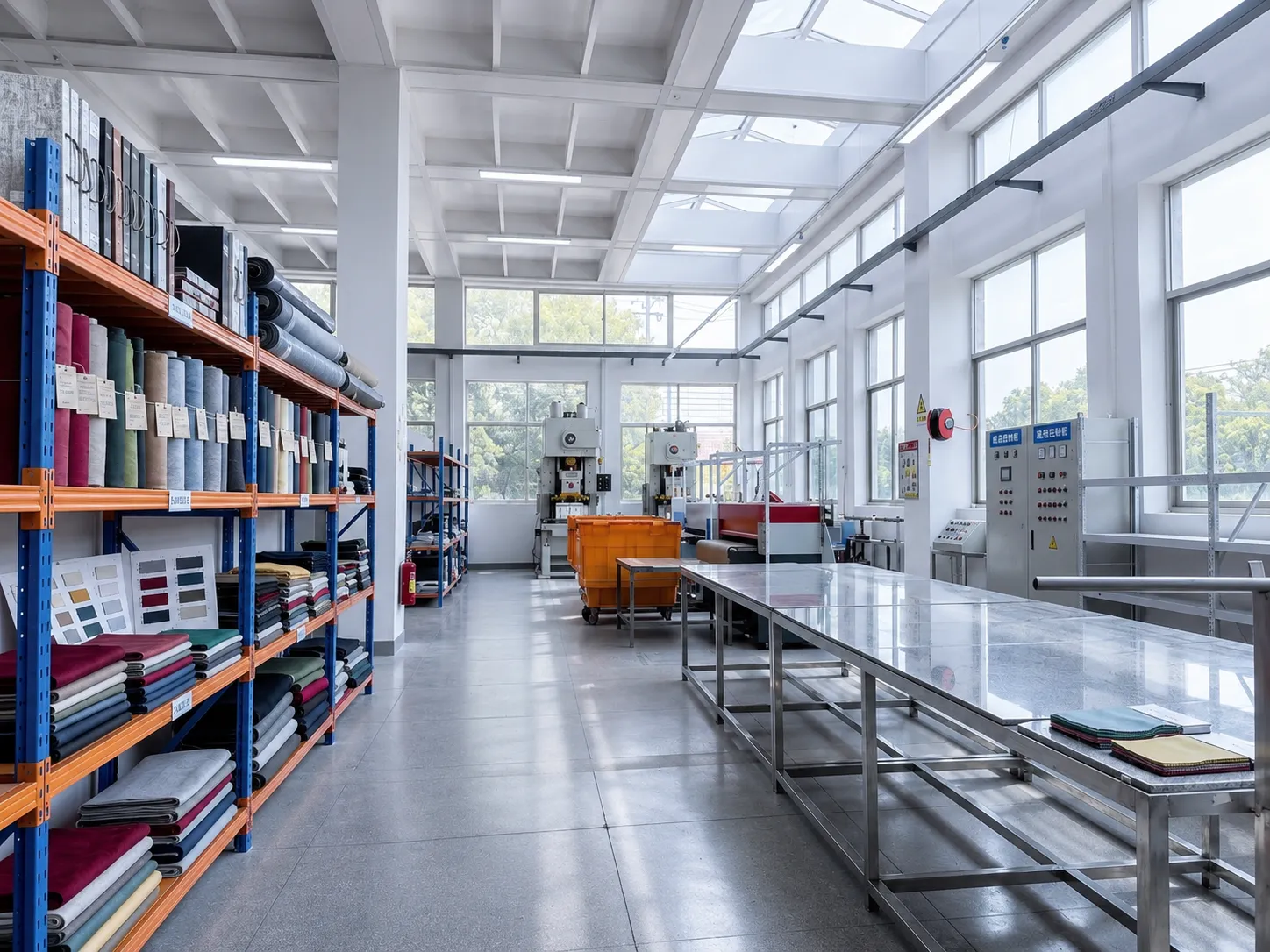
Our raw material area — material choice is the biggest driver of the per-pair price.
◆Material Swaps That Lower Cost Without Changing the Look
- Use leather only on visible panels and a matched microfiber on hidden ones.
- Choose a textile lining instead of leather where breathability matters more than feel.
- Use a stock lace and eyelet color instead of custom-dyed trims.
- Ask your shoe materials supplier contact at the factory for an equivalent from current stock.
🏗️How Construction and Complexity Affect the Price
How a shoe is put together decides equipment, labour time and tooling — and therefore price.
◆Construction Methods Compared
Cemented
The upper is lasted and the sole is glued on. Flexible and widely used, with moderate labour cost.
Cupsole
The upper sits inside a molded cup-shaped sole, often stitched around the side. Durable and classic for sneakers; the stitched version adds labour.
Vulcanized
Rubber sole parts are bonded and cured with heat. Typical of canvas skate shoes; efficient once set up, but requires specific equipment.
Direct Injection
The sole material is injected straight onto the lasted upper in a mold, removing a separate gluing step. It suits larger runs; read more about injection molding in footwear manufacturing.
◆Pattern Pieces and Stitching Operations
Every extra panel needs cutting, skiving and stitching. A sneaker with 25 upper pieces takes noticeably longer to make than one with 10, and that time is in the price.

Each pattern piece is cut, then stitched — more pieces, more labour per pair.
◆Decoration: Embroidery, Printing and Embossing
Embroidery is priced by stitch count, screen printing by color count and set-up, and embossing or debossing needs a small tool. Placing decoration on one panel rather than several keeps cost down.
📦How Order Quantity Changes the Unit Cost
Ask how much does it cost to make a shoe at 500 pairs and at 5,000 pairs and you will get two different answers. Quantity changes cost in two ways: one-off costs are spread over more pairs, and materials and set-up get cheaper per pair on longer runs.
◆Our MOQ: 500 Pairs per Style, Colors and Sizes Mixed
Our minimum order is 500 pairs per style, and you can mix colors and sizes inside that number. That lets a new brand cover several colorways and a full size run without ordering 500 pairs of every color or size.
◆Why the First Order Costs More per Pair
The first order carries the sample rounds, any private tooling and the material minimums for new colors. On a repeat order those costs are already paid, so the per-pair cost of the same shoe usually drops.
◆How Styles Multiply the Order
Because the minimum applies per style, every style you add raises the total order by 500 pairs, while colorways share the pairs inside each style. It is easy to plan a “small” first collection that turns out to be several thousand pairs.
A Worked Example: Styles × 500
📝 Order size calculator
3 styles × 500 pairs = 1,500 pairs, with 2 colorways inside each style
2 styles × 500 pairs = 1,000 pairs, split across any colors
1 style × 500 pairs = 500 pairs, even in 3 colorways
◆Practical Ways to Start With a Lower Total Order
- Launch fewer colorways and add more once sell-through data comes in.
- Build two or three styles on one sole so tooling is shared.
- Mix colors and sizes within each style rather than ordering separate runs.

Bulk production on our lasting and assembly line — longer runs lower the cost per pair.
🏷️Branding and Packaging Costs
Branding is what turns a factory shoe into your product. Most methods are inexpensive per pair, but some need a one-off tool.
◆Logo Methods and What Each One Costs
If you want to add logo to shoes, the method you choose decides whether there is a set-up cost.
Printed or Embossed Insole Logos
Printing on the sock liner is the lowest-cost option. Embossing or debossing needs a small metal tool but gives a more premium look.
Woven Labels and Heel Tabs
Woven labels on the tongue or heel are ordered by quantity with a small minimum and are cheap per pair.
Logos Molded Into the Outsole
A logo in the outsole needs either a private mold or a logo insert in the mold, so it is a tooling cost. It is the most permanent way to customize shoes with logo branding.
◆Shoe Boxes, Hangtags and Labels
A printed custom shoe box costs more than a stock box with a sticker, and the gap is largest on small orders because printing has a set-up cost. Hangtags, size labels and barcodes are low-cost but must be specified before production.
◆Retail Packaging vs Simple Polybag Packing
Brands selling in stores usually need a branded box. Brands shipping direct to consumers sometimes choose a polybag inside a mailer box, which costs less and reduces carton volume — and therefore freight.
🧪Testing and Compliance Costs
Testing protects you at customs and with retailers. Some tests are part of normal development; others are paid to an outside lab.
◆In-House Tests Included in Development
We run slip-resistance and abrasion tests in-house during development, so obvious sole problems are found before bulk production.
◆Third-Party Lab Tests by Market
EU: REACH Restricted Substances
Footwear sold in the EU must meet the REACH restrictions in Annex XVII. Examples buyers test for include chromium VI in leather in contact with skin, restricted to below 3 mg/kg, and PAHs in rubber or plastic parts that touch the skin. The full list is published in REACH Annex XVII.
US: CPSIA for Children’s Footwear and California Prop 65
Children’s shoes sold in the US must meet CPSIA limits — 100 ppm total lead in substrate materials and 90 ppm in paint and surface coatings — and be tested by a CPSC-accepted lab, according to the CPSC. Shoes sold in California may also need a Proposition 65 warning if they contain listed chemicals; see OEHHA’s Proposition 65 guidance.
◆Performance Test Standards Buyers Often Specify
◆Who Pays for Testing
Third-party lab tests are normally paid by the brand, either directly to the lab or arranged by the factory and passed through at cost. Labs price per test and per material or color, so a shoe with many materials costs more to test. Ask your retailer which tests they require before you book them.
🚢From FOB to Landed Cost: Freight, Duties and Other Charges
For an importer, the full answer to how much does it cost to make a shoe is the landed cost: what a pair has really cost you once it is in your warehouse. It is the number your pricing should be based on.
◆FOB, EXW and DDP Explained
These are Incoterms® rules published by the International Chamber of Commerce.
◆Sea Freight vs Air Freight
Shoes ship in bulky cartons, so sea freight is the normal choice for bulk orders and costs far less per pair. Air or express courier is used for samples and urgent top-ups. Packing more pairs per carton and choosing compact packaging lowers freight per pair.
◆Import Duties on Footwear
Footwear duties depend on the upper and sole material, the construction and the country of origin. In the US, the Footwear Distributors and Retailers of America reports that footwear tariffs average 23.6% and reach 48% or more on some types (FDRA); shoes made in China can also face additional tariffs that have changed several times since 2025. In the EU, standard rates for common footwear lines run from 8% to 17% depending on materials. Always confirm the current rate for your exact HTS or CN code with your customs broker before costing — check the US rate in the USITC Harmonized Tariff Schedule.
◆How to Calculate Landed Cost per Pair
The Formula
📝 Landed cost per pair
Landed cost = FOB price + (freight + insurance) ÷ pairs + import duty + (brokerage + port fees) ÷ pairs + (inland delivery) ÷ pairs
US duty is usually charged on the customs value, which is close to the FOB price; the EU charges duty on the CIF value, which includes freight and insurance.
A Worked Example
The numbers below are illustrative only — not a quote and not a current duty rate — to show how the formula works for a 3,000-pair sea shipment into the US.
📈From Landed Cost to Retail Price: How Brands Set Margins
Retail prices are built on top of landed cost, with room for the brand’s costs and the retailer’s margin.
◆Wholesale and Retail Markups
Brands that sell through stores typically sell to retailers at around half the retail price, and retailers double it. A brand selling direct to consumers keeps the retailer’s half, but pays for marketing, platform fees, returns and fulfilment instead.
◆Where the Money Goes in a $100 Pair of Shoes
A widely cited estimate first published by Sole Collector breaks a $100 Nike sneaker down as follows (WearTesters). It is an industry estimate, not Nike’s own data.
◆How Much Does a Nike or Jordan Shoe Cost to Make?
Nike does not publish per-model production costs, including for Jordan shoes, so any exact figure you see online is an estimate. What Nike does report is its overall gross margin — 42.7% in fiscal 2025, according to its annual report to the SEC. The breakdown above shows the general pattern: the factory price is roughly a quarter of the retail price, and most of the rest pays for marketing, distribution and retail.
✂️How to Reduce Shoe Manufacturing Cost Without Hurting Quality
Once you know how much does it cost to make a shoe in your current specification, these steps lower that cost without changing what your customer sees and feels.
◆Step 1: Sample on a Public Mold First
Prove the design and fit before paying for tooling. If the style sells, move it to a private mold for the next order.
◆Step 2: Build Several Styles on One Sole
One outsole can carry a low-top, a mid-top and a slip-on. Shared tooling is the biggest single saving for a new collection.
◆Step 3: Limit Styles in the First Order
Because the minimum applies per style, every style you cut lowers the total order and the cash you need upfront. Colors do not raise the minimum, but each new color can add its own material minimums.
◆Step 4: Simplify the Pattern
Merge panels that don’t need to be separate and reduce decorative stitching rows. Fewer pieces means less cutting and stitching time per pair.
◆Step 5: Choose Materials by Function, Not Habit
Put the premium material where the customer sees and touches it, and a cost-effective equivalent where they don’t.
◆Step 6: Mix Colors and Sizes Within Each Style
Order the size curve your market actually buys rather than equal quantities of every size, so you don’t fund unsold sizes.
◆Step 7: Move to a Private Mold for Repeat Orders
Once a style repeats, a private mold pays for itself over the following orders and gives you a sole no one else has.
📝How to Get an Accurate Shoe Quote
The most reliable way to learn how much does it cost to make a shoe for your own design is to request a quote. An accurate quote comes from a complete request. The more a factory knows, the fewer surprises there are later.
◆What Your Factory Needs Before It Can Quote
- Design drawings, a tech pack or a reference shoe
- Upper, lining and sole materials — or the target price and market
- Quantity per style and colorway, and the size range
- Branding and packaging requirements
- Target delivery date and destination market
◆How to Compare Quotes From Different Factories
Line quotes up on the same specification and quantity, separate one-off costs from per-pair costs, and check what is excluded. If you are still building a shortlist of shoe manufacturers in China, our guide covers how to vet them before you ask for prices.
◆Payment Terms and When Each Cost Is Paid
Sample fees and private mold fees are paid before that work starts. For bulk production we work on 30% deposit with the order and 70% before shipment, by bank transfer (T/T). Bulk production takes 28–35 days from PP-sample approval.
◆Ready to Price Your Own Shoe?
Send us your design, reference shoe or tech pack with target quantities, and we will reply with sample and tooling costs and an FOB price based on your actual specification. You can also start with the shoes we already make, such as our custom casual shoes, or contact our team directly.
❓Frequently Asked Questions About Shoe Manufacturing Costs
◆How Much Does It Cost to Make a Shoe?
It costs the factory’s per-pair FOB price plus your share of one-off costs. At SeeU Shoe, samples on an existing last and public mold start from US$28 per pair, a private outsole mold starts from US$700, and the minimum order is 500 pairs per style with colors and sizes mixed. Freight, duty and delivery are added on top of the FOB price.
◆How Much Does It Cost to Make a Sneaker?
A sneaker’s cost depends mainly on the upper material, the sole construction and the number of pattern pieces. A canvas vulcanized sneaker sits at the low end of the range; a full-grain leather sneaker on a stitched rubber cupsole sits at the high end.
◆How Much Does a Nike Shoe Cost to Make?
Nike does not publish the cost of individual shoes, including Jordan models. A widely cited industry estimate puts the factory price of a $100 Nike sneaker at about $25, with landed cost of about $28.50 after freight and duty.
◆How Much Does a Shoe Sample Cost?
At SeeU Shoe, samples built on an existing last and public mold start from US$28 per pair, from one pair, and take 3–7 days. The fee is credited back against your bulk order. Samples needing a new last or private sole cost more and take longer.
◆How Much Does a Shoe Mold Cost?
Using one of the factory’s public molds costs nothing. A private outsole mold for your brand starts from US$700 at SeeU Shoe and takes 7–15 days; the price rises with sole size, complexity and the number of sizes.
◆What Is the Minimum Order to Manufacture Shoes?
Our minimum order is 500 pairs per style, and colors and sizes can be mixed within that quantity.
◆Why Is the First Order More Expensive per Pair?
The first order carries one-off costs such as sample rounds and tooling, plus material minimums for new colors. On repeat orders those costs are already paid, so the per-pair cost usually falls.
◆Is It Cheaper to Manufacture Shoes in China?
China combines a deep supply of materials, components and soles with experienced footwear labour, which keeps per-pair prices competitive. Your landed cost also depends on the import duty for China-made footwear in your market, so compare landed cost, not just FOB.
◆What Does an FOB Price Include?
An FOB price covers the shoe, its packaging, inland transport to the export port and export clearance. It does not include sea or air freight, insurance, import duty, customs fees or delivery in your country.
◆How Much Does It Cost to Start a Sneaker Business?
Beyond the shoes themselves, budget for samples and any tooling, a first order of at least 500 pairs per style, freight and duties, packaging, product photography and marketing. Starting with one or two styles on a public mold keeps the upfront investment lowest.