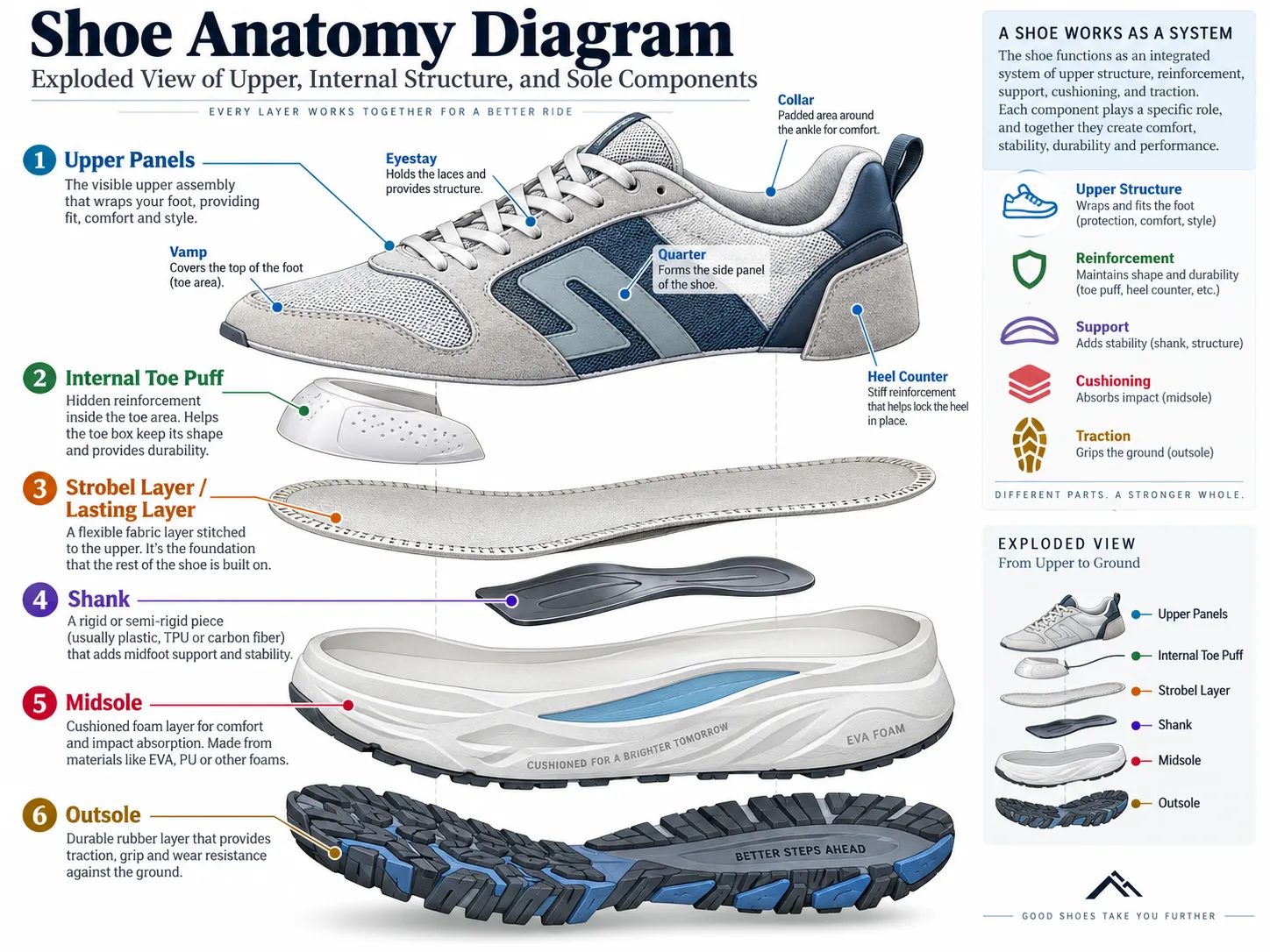

👟 Footwear Engineering & Structural Anatomy
💡 Core Concept: A shoe is far more than a simple piece of molded rubber attached to stitched fabric; it is a precision-engineered biometric structure designed to protect the human foot while maintaining biomechanical stability, comfort, and flex dynamics.
Understanding the complete parts of a shoe is essential for footwear designers, brand product managers, sourcing executives, and OEM quality assurance specialists.
🛠️ Strategic Value Across Operations
Execution & Quality Control
Whether you are auditing a factory line, building out a comprehensive technical pack (Tech Pack), or managing commercial mass production, mastering the detailed shoe anatomy allows you to specify exact raw materials, prevent bonding or fit failures, and control bill-of-materials (BOM) costs effectively.
⚠️ Important Notice: Precise definition of raw material technical specifications during the Tech Pack stage is mandatory to avoid catastrophic bonding degradation during mass manufacturing.
👟 What Are the Main Parts of a Shoe?
At the highest structural level, the overall anatomy of footwear is divided into two primary sub-assemblies: the shoe upper (everything that covers the top, sides, and heel of the foot) and the sole of a shoe (everything positioned underneath the foot that contacts the ground or absorbs impact).
🧩 Complete Shoe Anatomy Overview
When evaluating what is sole in shoes versus what constitutes the upper, procurement teams must treat these components not as isolated parts, but as an integrated mechanical ecosystem.
📊 Industry Data | A Shoe Is More Complex Than It Looks
Research conducted by the Massachusetts Institute of Technology (MIT) Materials Systems Laboratory found that a typical pair of running shoes can contain around 65 discrete parts and require more than 360 processing steps to manufacture and assemble.
These processes can include cutting, stitching, molding, foaming, heating, lasting, bonding, and finishing. This helps explain why footwear performance cannot be attributed to the upper or sole alone. The final shoe depends on how dozens of individual components are designed, processed, and assembled together.
For footwear buyers, more components can also mean more potential control points for material consistency, dimensions, bonding, alignment, and final inspection.
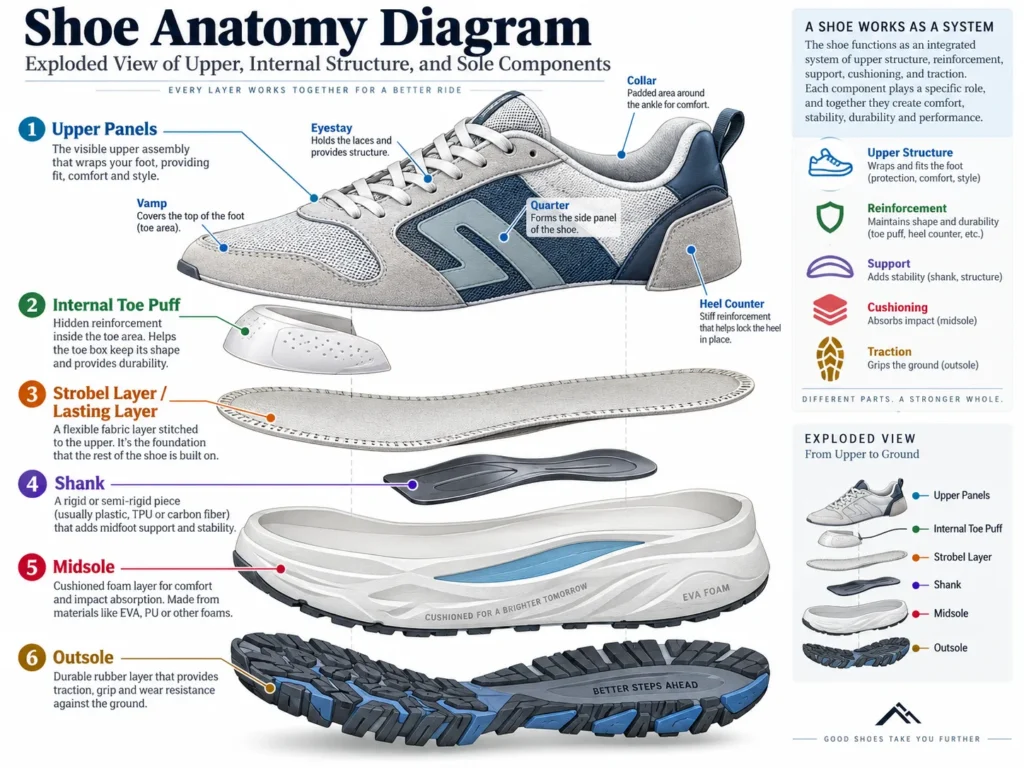
📐 Shoe Anatomy Diagram & Overview
To visualize how these parts of shoes interlock during technical lasting and assembly, refer to the component breakdown callout below:
🧵
Parts of the Shoe Upper
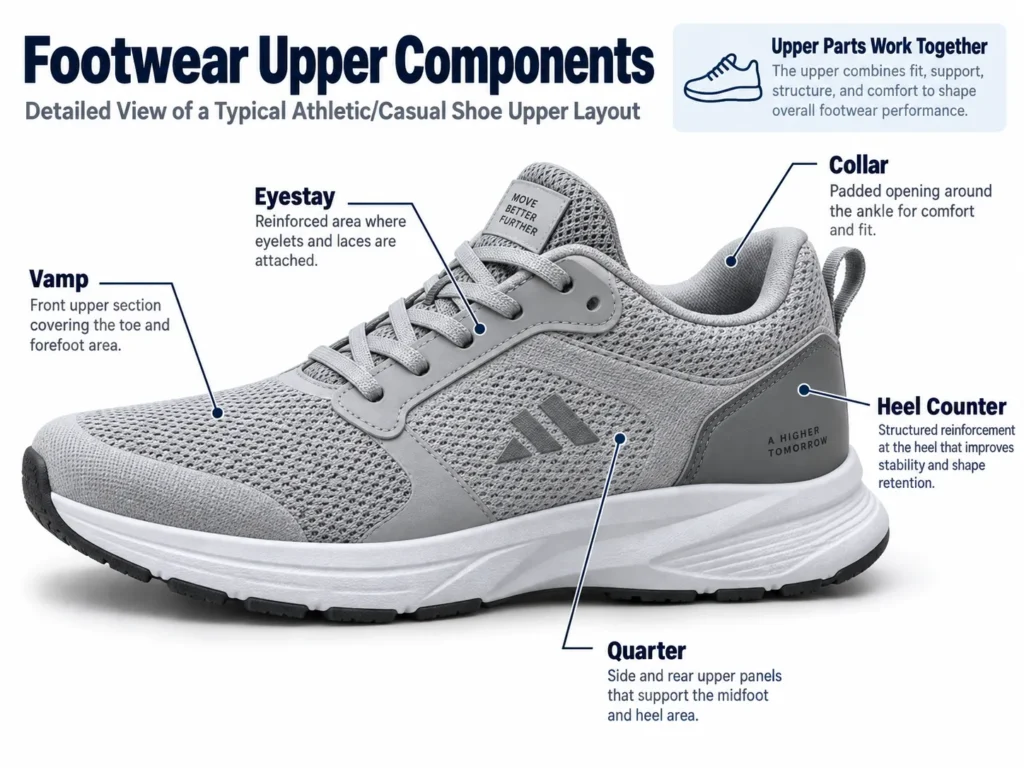
The shoe upper comprises all sections above the sole margin. It protects the foot from environmental debris, maintains structural containment, and dictates the aesthetic style of the shoe.
📊 Upper Components Quick Reference Guide
🔬 Detailed Component Specifications
🔸 Vamp
- Definition & Role: The shoe parts vamp is the section of the upper that covers the forefoot and instep, extending from the toe box back to the waist and quarter panels. It experiences the highest flexing stress during gait cycles.
- Common Materials: Full-grain cow leather, split suede, synthetic microfiber, high-tenacity engineered polyester mesh, knit textiles.
- Impact on Performance: Directly affects breathability, flex comfort, water resistance, and forefoot crease durability.
- Factory QC & Buyer Judgment: Flex-crack testing using ISO 17694 methods. Inspect for uniform material thickness (±0.1 mm) and grain consistency.
🔸 Quarter
- Definition & Role: The quarter panels cover the sides and rear portion of the shoe upper, extending from the vamp to the backstay and meeting around the heel.
- Common Materials: PU synthetics, nylon ripstop, ballistic canvas, tumbled leather, TPU overlays.
- Impact on Performance: Provides lateral torsional containment, midfoot lock-down, and heel positioning.
- Factory QC & Buyer Judgment: Check seam alignment and stitch density (3.5 to 4.0 stitches per cm). Verify tear strength at eyelet transition points.
🔸 Toe Box
- Definition & Role: The forward chamber surrounding and protecting the wearer’s toes.
- Common Materials: Molded leather, TPU film overlays, rubber toe caps, composite/steel protective caps (for safety footwear).
- Impact on Performance: Prevents toe stubbing, dictates forefoot volume, and preserves front profile shape.
- Factory QC & Buyer Judgment: Measure interior height clearance and lateral width against the approved shoe last. Ensure no collapsed edges after lasting.
🔸 Tongue
- Definition & Role: The flexible strip positioned beneath the eyestay that covers the instep (top of the foot).
- Common Materials: Sandwich mesh, open-cell polyurethane foam padding, neoprene, gusseted waterproof membrane fabrics.
- Impact on Performance: Crucial for instep pressure distribution, entry convenience, and weatherproofing.
- Factory QC & Buyer Judgment: Check centering alignment, foam thickness uniformity, and gusset stitching flexibility.
💡 What is the instep of a shoe? The instep is the arched upper surface of the human foot between the toes and the ankle. The shoe tongue cushions this sensitive area from lace bite and blocks dirt and water ingress.
🔸 Eyestay
- Definition & Role: The structural reinforcement strip running along the instep containing eyelets, lace loops, or speed hooks.
- Common Materials: Heavy synthetic leather, welded TPU sheets, molded plastic hardware, reinforced eyelet tape.
- Impact on Performance: Transfers lacing tension directly to the sole unit for secure midfoot closure.
- Factory QC & Buyer Judgment: Perform eyelet pull-out force testing (minimum > 250 N per eyelet).
🔸 Collar
- Definition & Role: The top rim surrounding the ankle opening of the shoe.
- Common Materials: High-density EVA foam, memory foam, soft calfskin leather lining, padded knitted textile.
- Impact on Performance: Prevents Achilles friction, seals the top of the shoe, and holds the rearfoot securely.
- Factory QC & Buyer Judgment: Ensure equal collar height on medial and lateral sides (±1.5 mm tolerance).
🔸 Heel Counter
- Definition & Role: The rigid or semi-rigid external or semi-internal structure enveloping the back of the heel.
- Common Materials: Molded TPU heel clips, heavy leatherboard, thermoplastic sheets, carbon fiber composites.
- Impact on Performance: Prevents heel slippage, controls calcaneal pronation, and stabilizes rearfoot strikes.
- Factory QC & Buyer Judgment: Verify vertical axis alignment relative to outsole center line. Check heel-cup firmness.
👟 Parts of the Shoe Sole
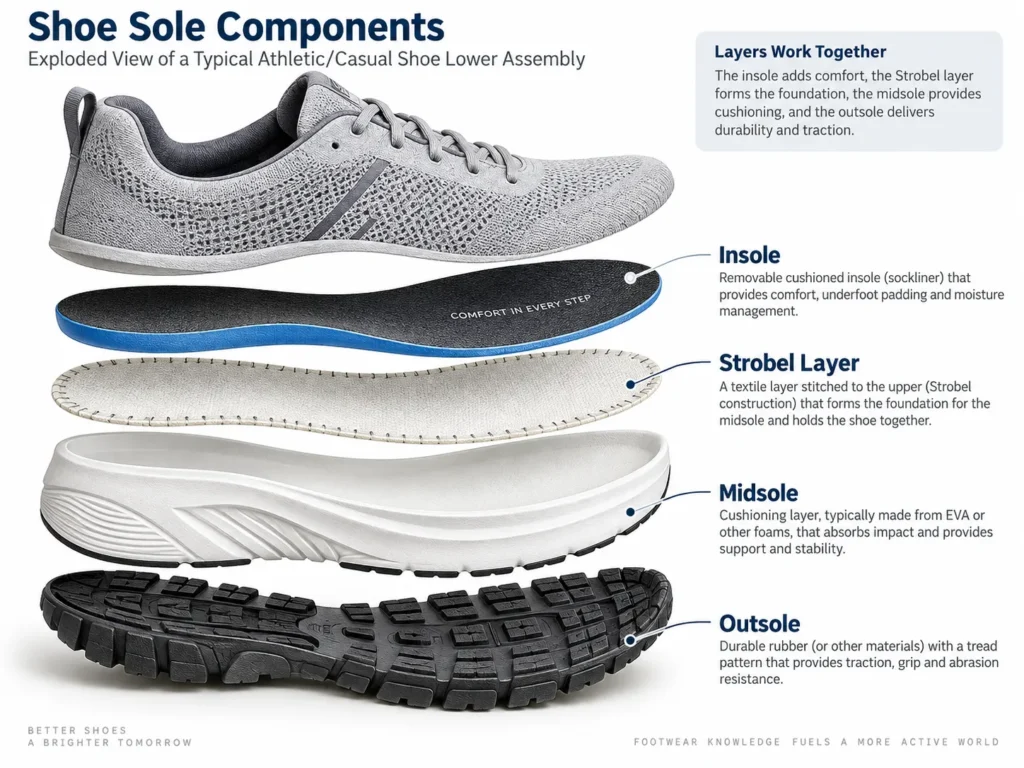
Understanding the lower sub-assembly—the sole of a shoe—is critical because it bears the entire body weight, cushions ground reaction forces, and delivers surface traction.
📊 Sole Components Quick Reference Guide
🔬 Detailed Sole Component Specifications
🔸 Insole
- Definition & Role: The internal footbed layer directly beneath the foot. It provides immediate step-in comfort, arch support, and moisture management.
- Common Materials: Molded EVA foam, open-cell Polyurethane (e.g., OrthoLite), cork, molded PU with gel pods.
- Impact on Performance: Controls plantar pressure distribution and step-in tactile feel.
- Factory QC & Buyer Judgment: Measure arch support contour height, compression set percentage (< 5% after 24h static load testing).
🔸 Midsole
- Definition & Role: The primary shock-absorbing layer situated between the upper/lasting board and the bottom outsole.
- Common Materials: Compression-molded EVA (CMEVA), Supercritical Foamed TPU, Polyurethane (PU), PEBA/Pebax.
- Impact on Performance: Dictates stack height, energy return, cushioning softness, and torsional stiffness.
- Factory QC & Buyer Judgment: Test Asker C hardness (45C to 55C depending on category). Check foam density (g/cm³).
⚙️ What is shoe midsole engineering? The shoe midsole compresses under load to damp mechanical impact energy and expands to return kinetic energy during toe-off.
🔸 Outsole
- Definition & Role: The bottommost exterior surface that directly contacts the terrain, providing traction and wear protection.
- Common Materials: Vulcanized natural rubber, synthetic nitrile rubber, Thermo-Plastic Rubber (TPR), direct-injection Polyurethane (PU), sticky rubber compounds.
- Impact on Performance: Traction coefficient, abrasion resistance, slip resistance on wet/oily surfaces, outdoor durability.
- Factory QC & Buyer Judgment: DIN abrasion resistance testing (< 120 mm³ volume loss per ISO 20871 / ISO 17707). Wet slip friction testing per SATRA TM144 standards.
💡 What is outsole of a shoe? The outsole of a shoe is the bottommost exterior surface that directly contacts the terrain, providing traction and wear protection.
🏷️ What is the bottom of a shoe called? In general trade terminology, the bottom of shoe called or shoe bottom called refers collectively to the outsole tread and ground-contact platform.
🔸 Welt / Strobel / Lasting Board
- Definition & Role: The structural foundation joining the upper to the sole unit.
- Construction Types:
- Strobel Board: A non-woven fabric sheet stitched to the bottom edge of the upper (Strobel construction) for flexible lightweight shoes.
- Lasting Board: A rigid paperboard/fiberboard base onto which uppers are cement-tacked (Traditional Board Lasting).
- Welt: A strip of leather, rubber, or plastic welted around the perimeter join (Goodyear Welt construction).
- Common Materials: Non-woven polyester Strobel cloth, high-density cellulose fiberboard, genuine leather strip.
- Impact on Performance: Determines torsional flex, structural integrity, and sole flexibility.
- Factory QC & Buyer Judgment: Check stitch density on Strobel seam (4 stitches per inch). Ensure lasting margin adhesion exceeds 3.5 N/mm.
🔍 Hidden Structural Components
While upper panels and outsoles are immediately visible, crucial hidden structural components within the anatomy of a shoe control shape retention, arch stability, and flex control.
📊 Hidden Internal Structural Layers
🔬 Detailed Component Breakdown
🔸 Toe Puff
- Definition: A heat-moldable or solvent-activated internal reinforcement sheet placed between the outer vamp material and interior lining at the toe tip.
- Materials: Extruded solvent-dip fabric, thermoplastic sheets with styrene-butadiene resin, hot-melt non-woven composites.
- Function: Maintains the original dome shape of the toe box and prevents collapsing when kicked or crushed.
🔸 Heel Counter Board
- Definition: An internal semi-rigid cup sandwiched between the rear upper material and heel lining.
- Materials: Thermoplastic resin impregnated fabric, laminated leatherboard, injection-molded TPU heel cup.
- Function: Provides calcaneal alignment, locks the heel against the footbed, and prevents heel slippage during walk/run gait phases.
💡 Factory Insight | Small Hidden Components Can Change the Entire Shoe
In more than eight years of footwear development, I have seen many fitting and shape problems caused by components that customers cannot see from the outside. Toe puffs and heel counters are good examples.
During a trial mass production run for an outdoor hiking boot, our QA team identified that the forefoot felt unusually stiff during step-flex tests, forcing the shoe to bend 12mm behind the intended flex line.
Investigation revealed that the factory assembly team had applied a 1.8mm heavy-duty thermoplastic toe puff extending 25mm too far back into the vamp flex zone. We reduced the puff extension by 20mm, trimmed material thickness to 1.2mm with skived edges, and recalibrated the activation heater temperature to 110°C. Flex resistance dropped by 35%, restoring the natural foot flex line while retaining 100% toe box shape memory.
For this reason, during sample development we do not simply check whether a toe puff or heel counter is present. We evaluate its material, thickness, coverage area, position, and how it works with the surrounding upper materials.
Two shoes can use the same upper material and outsole but still have very different shape retention, fit, and wearing comfort because of these hidden structural components.
🔸 Shank
- Definition: A narrow, rigid structural insert embedded inside the waist/arch area between the insole board and outsole.
- Materials: Tempered spring steel, molded fiberglass, heavy-duty TPU, carbon fiber plate.
- Function: Supports the arch of the foot, prevents torsional twisting across the midfoot, and ensures the shoe flexes at the metatarsal joints rather than under the midfoot arch.
🔸 Reinforcement Tapes & Backings
- Definition: Thin, high-tensile woven tapes and non-woven adhesive fabrics applied behind eyelet holes, seam joints, and top lines.
- Materials: Nylon seam reinforcement tape, hot-melt film overlays, non-woven microfiber backer.
- Function: Prevents leather stretch over time, stops eyelets from tearing out under lacing pressure, and reinforces high-stress stitch lines.
👟 How Shoe Components Affect Fit
A key responsibility for B2B footwear buyers is ensuring that shoes fit consistently across all size runs. Fit is governed by how internal component dimensions interact with human foot anatomy.
📊 Component Dynamics Affecting Shoe Fit
💡 Factory Insight | Fit Is a System, Not a Single Measurement
After more than eight years working in footwear development and production, one thing I have learned is that shoe fit cannot be judged by the last alone. A last may have the correct width and volume, but thicker lining, tongue foam, insoles, or internal reinforcement can reduce the actual space available to the foot.
In one notable development project for a technical trail runner, fitted samples felt two sizes too tight across the instep despite using an audited EE-width last. Our teardown analysis revealed that combined upper padding—a 10mm tongue foam layer, a 2.0mm waterproof membrane backer, and an ultra-thick 8mm PU insole—eroded over 14% of the internal volume.
We re-engineered the lining spec to 5mm high-density foam and reduced insole forefoot depth to 4mm. Instep perimeter room instantly increased by 8.5mm, achieving exact fitting compliance without costly last remolding.
During sample development, we therefore evaluate the last, upper, lining, tongue, footbed, and sole construction as one complete fit system rather than adjusting only one component. This is one reason why two shoes built on similar-looking lasts can still feel noticeably different when worn.
To master this balance, buyers must closely monitor the shoe development process and ensure proper shoe last development before commercial toolings are finalized.
☁️ How Shoe Components Affect Comfort
Footwear wearing comfort is determined by three core physical variables: pressure distribution, shock damping, and internal thermal-moisture control.
📊 Triad of Footwear Comfort
🔬 Detailed Comfort Mechanics
🔸 1. Pressure Distribution
A contoured insole redistributes weight away from high-pressure points (calcaneus and metatarsal heads) across the midfoot arch.
🔸 2. Impact Damping
Low-density midsoles (Asker C 40°–48°) absorb peak ground reaction forces during heel strike, reducing biomechanical load on knees and lower back joints.
🔸 3. Moisture & Thermal Management
Lining materials like mesh knitted textiles combined with perforated foam linings pump heat and moisture outward, preventing blister formation.
💡 Key Takeaway: Achieving optimal footwear comfort requires precise balancing of insole contouring, midsole hardness, and upper material breathability working in unison.
🛠️ How Shoe Components Affect Durability
Durability failure in mass production is rarely caused by a single material failing; it typically occurs along the interface seams and bonded joints connecting different parts of shoes.
📊 Critical Failure Modes in Shoes
According to international safety standards such as ISO 20344 (Footwear Testing Methods) and ASTM F2413 (Performance Requirements for Protective Footwear), bonding strength between the upper and sole unit must exceed 4.0 N/mm of width for heavy-duty work shoes and 3.0 N/mm for casual footwear.
🏭 Factory Case | TPU Sole Bonding Failure at the Toe
In one of our production runs for TPU-soled work shoes, the molded soles looked normal and their dimensions were within our production requirements. However, during flex checks, we began to see separation between the upper and sole around the toe area.
After tracing the problem back through the production line, we found that the TPU sole itself was not the main cause. The lasting surface of the upper had not been roughened and primed consistently before injection, which reduced the quality of the bond between the upper and molten TPU.
We added a fixed roughening-and-primer process with an inspection checkpoint before each upper entered the mold and tightened the injection-temperature control window. After those changes, peel failures on that model dropped to close to zero in our internal testing.
This case is a useful reminder that footwear durability is rarely determined by one component in isolation. The upper, outsole, surface preparation, materials, and joining process all have to work together.
Source: SeeU Shoe factory production case.
💰 How Shoe Components Affect Manufacturing Cost
Understanding component cost breakdown allows brand product managers to optimize Bill-of-Materials (BOM) target pricing during development.
📊 Typical Footwear BOM Cost Breakdown (% Total)
⚙️ Key Cost Drivers in Footwear Production
🔸 1. Upper Material Consumption & Yield
Full-grain natural leathers yield approximately 60% to 70% usable area due to natural surface defects, whereas synthetic microfiber or mesh roll goods yield >90%, lowering raw material costs significantly.
🔸 2. Outsole/Midsole Tooling (Molds)
Injection molding tooling for a full size run (US 6–13, including half sizes) requires 14–16 individual steel/aluminum mold sets. A complex dual-density EVA/Rubber mold set can cost upwards of $3,000 to $5,000 per size, adding upfront capital expenditure.
🔸 3. Labor Assembly Intensity
High component counts (e.g., a retro sneaker with 30 stitched upper overlays) require higher labor minutes on the stitching line compared to a single-piece engineered knit upper.
🎯 Conclusion & Next Steps
Mastering every component across the complete parts of a shoe empowers footwear brands to design higher-performing products, streamline factory production, prevent quality defects, and optimize procurement margins.
🚀 Ready to Bring Your Footwear Designs to Life?
Ready to bring your footwear designs from concept to full-scale OEM/ODM production? Contact our engineering team today to discuss your footwear project or learn more About SeeU Shoe and our specialized manufacturing capabilities.
❓ Frequently Asked Questions (FAQ)
Quick answers to essential questions regarding shoe anatomy, internal structural components, sole unit layers, and international testing standards.
📊 FAQ Quick Reference Guide
💡 Detailed Answers
🔸 1. What is the bottom of a shoe called?
Answer: The bottom of a shoe is officially known as the outsole. The outsole is the exposed bottom surface that makes direct contact with the ground, providing friction, grip, and wear resistance. In a complete sole unit, the bottom assembly also includes the shock-absorbing midsole directly above the outsole.
🔸 2. What is outsole of a shoe vs midsole?
Answer: The outsole of a shoe is the exterior bottom rubber or TPU layer designed to resist ground abrasion and provide slip resistance. The midsole is the internal cushioning layer sandwiched between the outsole and upper, engineered using EVA or PU foams to absorb joint impact and deliver kinetic energy rebound.
🔸 3. What is the instep of a shoe?
Answer: The instep of a shoe refers to the upper middle portion of the shoe covering the arched top surface of the foot between the toes and ankle joint. It is cushioned by the shoe tongue and adjusted using the lacing eyestay to secure the foot inside the shoe.
🔸 4. What is sole in shoes and what components are included?
Answer: In footwear trade terminology, what is sole in shoes refers to the entire lower structural assembly beneath the foot. It comprises four key components: the insole (footbed), lasting board (Strobel cloth), cushioning midsole, and treaded outsole.
🛡️ 5. Why are hidden structural components like toe puffs and shanks important?
Answer: Hidden components like toe puffs, heel counters, and steel shanks maintain the structural integrity and ergonomics of the shoe. Without a proper shank, the shoe arch can collapse under body weight, while a missing toe puff causes the front profile to cave in during normal wear.
🔸 6. What is the role of the collar of a shoe?
Answer: The collar of a shoe is the padded upper rim surrounding the ankle opening. It provides Achilles tendon support, seals the ankle against debris, prevents friction blisters, and stabilizes heel lock-down during movement.
🔸 7. How does a Strobel board differ from a traditional lasting board?
Answer: A Strobel board is a flexible non-woven textile sheet stitched directly to the upper edge using a Strobel machine, ideal for flexible athletic shoes. A traditional lasting board is a rigid cellulose fiberboard onto which upper margins are pulled and cemented, commonly used in structured dress shoes and heavy work boots.
🔸 8. What standard test methods ensure outsole abrasion resistance?
Answer: Outsole abrasion resistance is globally evaluated using international testing standards such as ISO 20871 and ISO 17707 (or SATRA TM174), which measure cubic millimeter volume loss under a revolving abrasive drum. High-durability outsoles must keep volume loss below 100 mm³.