

A Leisten is the solid, foot-shaped form that a shoe is built around. Every upper is pulled over it, every sole is fitted to its bottom, and every size in a range is graded from it. If you have ever wondered why two shoes marked with the same size fit so differently, the answer usually starts with the last.
This guide explains what a shoe last is, which last dimensions control fit, the main types of shoe lasts and the materials they are made from, and how a brand should select, check and approve a last before bulk production. It is written for buyers at footwear brands and retail chains who need to write clear specifications and judge samples with confidence.
💡Kurzantwort
👟What Is a Shoe Last?
The simplest shoe last meaning is this: a last is the model of the inside of a shoe. It is not a copy of a human foot. A foot is soft, it spreads when you stand, its toes move and its shape changes through the day. A last is rigid and deliberately idealised. It already includes the extra length the toes need, the room the forefoot needs when it flexes, the slight lift at the toe that helps the shoe roll forward, and the heel height the finished shoe will have. Shoe lasts are therefore design tools as much as manufacturing tools: they decide how a shoe will feel long before anyone chooses a leather or a sole.
◆What Does a Shoe Last Look Like?
A shoe last looks like a smooth, solid foot without toes. Seen from the side, it has a curved bottom that follows the heel height and toe spring of the intended shoe. Seen from above, it shows the toe shape — round, almond, square or pointed — and how much the forefoot turns inward or stays straight. The top of the last is usually cut flat at the ankle, where you will often find a metal plate or a hole called the thimble, which lets the last sit on lasting machines and be pulled out after the shoe is finished.
Many production lasts are hinged near the instep so they fold slightly and come out of a closed shoe without stretching the collar. Each last is also marked with its last number, size, left or right foot and width fitting — the references a factory uses to match lasts to orders.
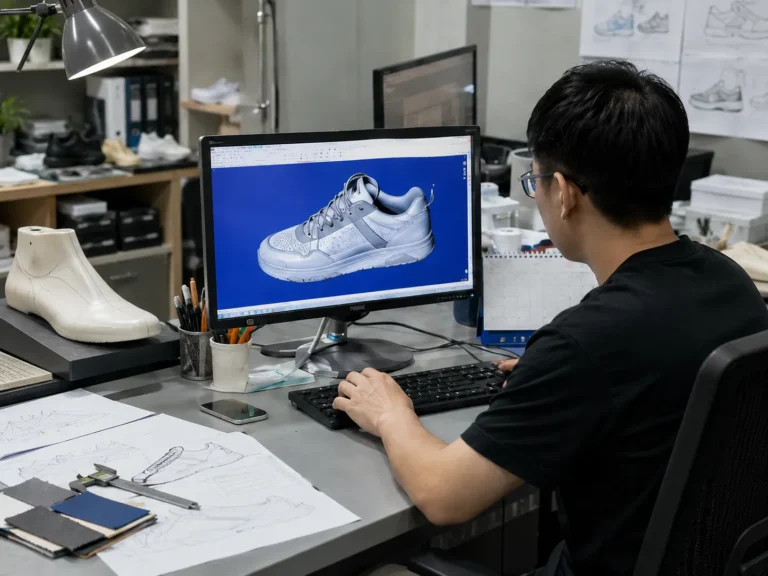
A physical shoe last beside the 3D model of the shoe being developed on it.
◆What Is the Purpose of a Shoe Last?
A shoe last has four jobs, and a buyer benefits from knowing all four:
- It shapes the upper. Flat pieces of leather or textile only become a three-dimensional shoe when they are stretched, moulded and fixed over a last.
- It sets the internal space. The volume inside the finished shoe is the volume of the last plus the thickness of linings and padding. That space decides whether the shoe feels roomy, snug or tight.
- It is the reference for patterns and soles. Pattern makers take the shape of the upper pieces from the last, and outsole and insole board shapes are built from the last bottom.
- It holds the size system together. Each size in a run comes from its own last, graded from the sample size. If the grading is wrong, the range will fit unevenly even when the sample size is perfect.
◆Where Is the Shoe Last Used in the Shoe Development Process?
The last appears early and stays to the end. The brief becomes a last choice or modification, the upper pattern is drawn on it, samples are made on it, fit feedback goes back into it, and only then are production lasts made. On the lasting line, uppers are pulled over lasts and soles attached before the last is removed at finishing.
So the last is one step in a longer chain, but it is the step every later step depends on. If you want to see where it sits among the other stages — requirements, patterns, materials, trial fitting, construction and finishing — our overview of the full Schuhentwicklungsprozess walks through each step in order.
⭐Why Is the Shoe Last So Important in Footwear Development?
In footwear development, the last is where most of the fit is decided and where most of the cost of a bad decision is created. A wrong colour can be changed on the next sample. A wrong last usually means new patterns, a new sole match and another sample round. That is why experienced developers treat the last as the first technical decision, not a detail to tidy up later.
◆The Last Defines the Basic Shape of the Shoe
The shoe shape a customer sees — toe silhouette, sleek or chunky profile, heel height, taper — comes from the last. The upper adds details and the sole adds thickness, but neither turns a round-toe last into a sharp almond shoe. A reference photo saying “we want this shape” is really a request for a last.
◆The Last Controls Internal Foot Space
Toe box height, forefoot width, instep room and heel width are all fixed by the last. Padding and insoles can take space away, but nothing in the upper adds space the last lacks — so a “roomy” or “wide” shoe starts with a roomier or wider last, not softer materials.
◆The Last Affects Fit, Comfort and Size Consistency
Shoe fit is the relationship between foot, last and materials. Most complaints — rubbing toes, pinching at the ball, slipping heels, pressure on top — trace back to one or two last dimensions. A size 6 and a size 11 only feel like the same shoe if every last in the run was graded correctly.
◆The Last Influences Upper Pattern and Sole Development
Patterns are drawn on the last’s surface and soles are matched to its bottom, so changing the last changes both. That is why the last should be fixed before investing in a private outsole mold: a mold cut for the wrong last bottom cannot be adjusted cheaply.
📏What Parts of a Shoe Last Affect Shoe Fit?
When buyers discuss shoe last dimensions with a factory, the conversation should be about specific measurements, not adjectives like “a bit tighter”. The table below summarises the dimensions that matter most for fit, followed by an explanation of each.
📊Industry standard — ISO 19409:2022
Last dimensions are not just factory jargon. According to ISO 19409:2022, Footwear — Sizing — Measurement of last dimensions, the basic dimensions of a last can be measured either physically on a real last or virtually on a digital 3D model, and the methods apply to all types of lasts. The standard also notes that last dimensions do not necessarily correspond with anatomical foot positions — a useful reminder that the last is a designed object, not a copy of a foot. For buyers, the practical value is simple: when both sides measure the same points in the same way, “ball girth 232 mm” means the same thing in your office and in the factory.
◆Toe Shape and Toe Box Volume
The toe box’s width, height (toe depth) and taper decide whether toes can spread or are pressed together. A sharp toe shape reduces volume, so designers add length in front of the toes to compensate. Ask for toe depth and width at the test size, not only a photo — especially if your customers have wide forefeet or bunions.
◆Forefoot Width and Ball Girth
Forefoot width is the straight width across the ball of the last; ball girth is the tape measurement around it. Two lasts can share a width yet differ in girth — one flat and wide, one narrower but deeper. Too tight here hurts with every step; too loose lets the foot slide forward into the toe.
◆Instep Height and Instep Girth
Instep height and girth decide whether a lace-up closes comfortably and whether a slip-on stays on. Too little gives pressure customers describe as “tight even though the size is right”; too much makes a loafer fall off at the heel. It is the dimension most often missing from briefs.
◆Heel Width and Heel Curve
The last sets heel width and the back (heel) curve. Too wide, or a curve that misses the heel, and the heel lifts; too narrow and it rubs. It matters most in low-collar shoes, slip-ons and slippers, where little else holds the foot.
◆Arch and Waist Shape
The waist is the narrow area between ball and heel, and its bottom follows the arch. A flat waist suits shoes that get a supportive footbed later; a shaped waist feels closer and more structured. Waist changes also change the outsole and insole board.
◆Overall Last Length
Last length is always longer than the foot length it represents; the difference is toe allowance for the toes to move forward as the foot flexes. A pointed dress shoe needs more allowance than a round-toe sneaker, and a hiking shoe needs enough for descents. A length error in grading shows up across the whole range.
🏭Factory experience — May 2022
In our footwear development workshop, we found that even a 2–3 mm change in forefoot width or instep volume could noticeably affect fitting during sample trials. A change that small is hard to see by eye, yet our fit testers could tell the difference between two samples immediately. For every new last, we therefore check length, ball width, instep girth and heel fit before releasing the last for upper pattern development, and we record those four numbers on the development sheet so the same last can be reproduced exactly.
🧩How Does a Shoe Last Affect the Final Shoe Shape?
The finished shoe shape is the shoe last shape plus the thickness of the upper and the sole. Designers can disguise some things with styling, but the main silhouette — toe shape, volume and proportions — is fixed when the last is chosen.
◆Round Toe, Square Toe and Pointed Toe Shapes
A round toe follows the toes most closely and suits sneakers, casual and comfort shoes. A square toe adds front width and a workwear or contemporary look. A pointed or almond toe looks slimmer but needs extra length beyond the toes. Compare the space inside at the same size, not just outlines — similar outlines can hide very different toe depths.
◆Low-Volume vs High-Volume Fits
A low-volume last hugs the foot for performance and fashion styles; a high-volume last adds depth over the instep and toes for comfort shoes, older customers and orthotic wearers. State the intended volume in the brief and back it with an instep girth target.
◆Slim Fit vs Wide Fit Shoes
Wide fit shoes need wider lasts, not softer leather on the same last. A width fitting changes ball width and girth, and usually waist and instep girth, at the same length — so each width is a separate graded set of lasts, a cost best justified by sales data.
📊Industry data — SATRA Global Foot Dimensions report, 2012–2016 survey
The case for width fittings is supported by measurement data. Between 2012 and 2016, SATRA used 3D scanning to capture thousands of feet in the UK, the USA and China, recording measurements including foot breadth, joint girth and instep girth. As published in SATRA’s Global Foot Dimensions report, offering UK women’s sizes 1 to 11 in an average ‘D’ fitting accommodated only 24.5 per cent of UK women, while offering sizes 5 to 7 in fittings ‘C’ to ‘E’ raised population coverage to 47 per cent. For a retailer, the lesson is that adding widths in the most common sizes can serve more customers than adding more lengths in one width.
◆How Last Proportions Affect the Shoe Silhouette
Proportion links length, width, toe height, heel height and the curve of the last bottom. Low toe height and a long front look sleek; high toe spring and a rounded front look sporty. Toe spring also changes how the shoe rolls forward. Changing proportions after approval is risky, because pattern and sole were drawn to the originals.
🗂️What Are the Main Types of Shoe Lasts?
Shoe last types are usually grouped by who will wear the shoe and what the shoe is for. The groups overlap — a women’s casual sneaker last is both a women’s last and a casual last — but each grouping brings its own fit priorities.
◆Men’s Shoe Lasts
Men’s lasts have a broader heel and forefoot and a larger size range. The large sizes need careful width grading so that sizes 12 and 13 feel like the sample size, not sloppier.
◆Women’s Shoe Lasts
Women’s lasts have a slimmer heel relative to the forefoot. Every heel height needs its own last, because raising the heel changes the foot angle, toe spring and instep shape.
◆Children’s Shoe Lasts
Children’s lasts prioritise toe room, a stable base and low heels, graded in small steps. Fit allowances matter more here because children rarely describe discomfort.
◆Casual Shoe Lasts
Casual lasts cover sneakers, loafers, slip-ons and everyday leather shoes, usually with a round or soft almond toe and moderate volume. One casual last often carries several styles in a collection, so choosing it well pays off. If you are planning individuelle Freizeitschuhe, deciding the last before styling the uppers will save sample rounds.
◆Sports Shoe Lasts
Sports lasts are shaped around movement. Running shoes need a heel that locks in, a forefoot that flexes at the right point, and a toe spring that helps the foot roll through each step. Sports lasts are also where you will hear about curved, semi-curved and straight lasts. A curved last turns inward at the front and suits lighter, faster shoes. Straight last shoes — sometimes called straight lasted shoes — have a straighter medial line and a wider base under the midfoot, giving more stability, and are often chosen for runners who need support.
◆Hiking and Outdoor Shoe Lasts
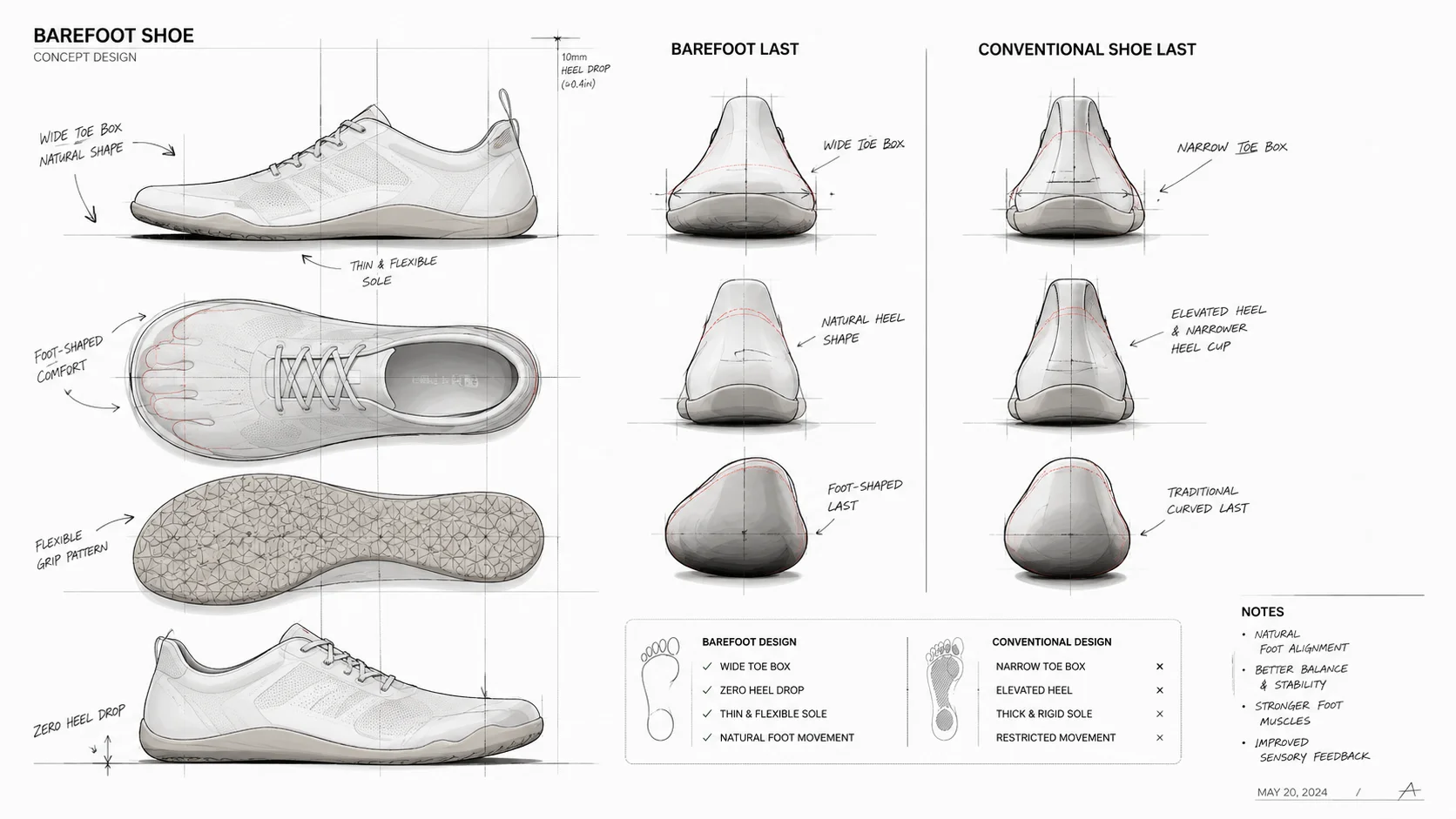
Hiking lasts need room in the toe box for descents, a secure heel, and space for thicker socks. Mid and high hiking styles use a boot last, which extends higher at the back and over the instep to fit the ankle area and the shaft of the boot. Barefoot-style outdoor shoes take a different direction: a foot-shaped toe box, zero drop and a thin, flexible bottom. For brands working on Entwicklung von Outdoor- und Sportschuhen, the last should be chosen together with the planned outsole, because lug depth and rubber wraps depend on the last bottom shape.
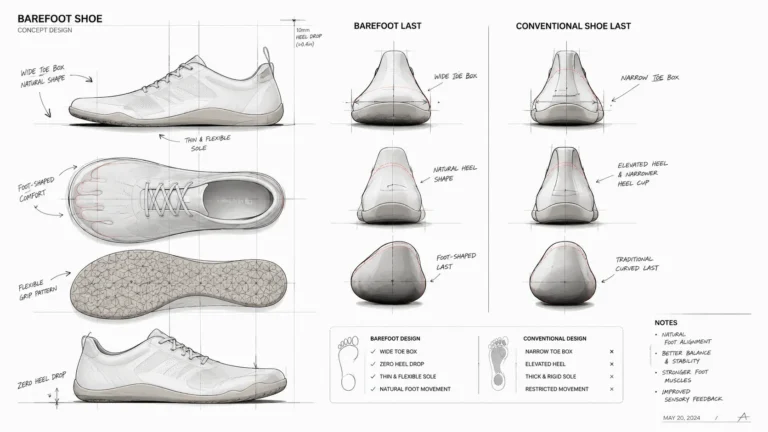
A development drawing from our sample room comparing a barefoot last with a conventional last.
◆Comfort and Slipper Lasts
Comfort and slipper lasts are wider and higher in volume, with low heels. Slippers are worn on bare, swelling feet, so heel hold and toe room matter more than silhouette, and the last is often paired with a contoured or cork footbed. For custom comfortable slippers, testing the last with the actual footbed material is essential, because soft footbeds compress and change the fit.
◆Medical and Extra-Depth Shoe Lasts
Medical and extra-depth lasts are designed for feet that need more room: room for removable orthotics, for swelling, for dressings and for deformities such as bunions or hammer toes. They depend heavily on four dimensions — width, depth, instep and toe box volume — and they are usually offered in several width fittings. Openings and closures matter too, because many wearers have limited reach or are helped by a carer. In medical footwear development, the depth that matters is the depth that remains once the insole or orthotic is in place, so it should be measured that way.
🪵What Materials Are Shoe Lasts Made From?
Shoe last material affects durability, accuracy, cost and which manufacturing processes the last can survive. The four materials buyers are most likely to hear about are wood, plastic, polystyrene and aluminum.
◆Wooden Shoe Lasts
Wooden shoe lasts, carved from dense hardwoods such as beech, maple or hornbeam, can be shaped and built up by hand, which keeps them in bespoke and high-end handmade work. But wood moves with moisture and wears with use — a risk in volume production.
◆Plastic Shoe Lasts
Plastic shoe lasts, usually high-density polyethylene, are the factory standard. Machined from a master model, they reproduce every size accurately, take tacks on the lasting line, do not swell, and can be hinged for removal. “A full run of lasts” almost always means plastic.
◆Aluminum Shoe Lasts
Aluminum shoe lasts are used where the shoe meets heat and pressure while still on the last, such as direct injection soling and some vulcanised or heat-set constructions. They cost more and are slow to change, so they are kept for programmes that need them.
◆When Is Each Last Material Used?
Polystyrene shoe lasts and similar foam forms serve early shape studies and concept models, never production. Wood suits bespoke work, plastic covers almost all factory sampling and bulk, and aluminum follows the construction method. You rarely need to specify last material, but do confirm production lasts come from the same approved master as the sample last.
⚖️Standard Shoe Last vs Custom Shoe Last
Every brand eventually faces the choice between working on an existing last or developing its own. The table compares the two.
◆What Is a Standard Shoe Last?
A standard shoe last is one the factory already holds from earlier programmes, usually as a library of common toe shapes and volumes. It is the fastest route to a 3D sample; in our sample room, a first sample on an existing last and outsole typically takes three to seven days.
◆What Is a Custom Shoe Last?
A custom shoe last is shaped for one brand’s fit or design — a modified existing last or a new one, graded into a full size run. A bespoke shoe last is the extreme case: made for one person’s feet, usually in wood.
◆When Can a Brand Use an Existing Last?
When you are testing a design or price, your customer has an average foot, the toe shape and volume already suit, and you will sell one width. Many strong first collections carry their identity in the upper and branding, on a well-chosen standard last.
◆When Is Custom Last Development Necessary?
Custom development is the better choice when fit is part of the product promise — wide fittings, extra depth, a signature toe shape — when existing lasts have caused repeated fit complaints, when the brand wants to own a fit that competitors cannot copy, or when a private outsole mold is planned, because the mold should be built around the final last bottom. The steps involved in turning a brief into a new last — measurement targets, digital modelling, fitting samples and grading — deserve their own guide, and we cover how a custom shoe last is developed separately.
🧭How Is a Shoe Last Selected for a New Footwear Project?
Shoe last selection is easiest when it follows a fixed order. The steps below are the order we use with brands, and you can use them as a checklist when you brief any factory.
◆Start With the Target Shoe Category
Schritt 1. State the category and construction before anything else: casual sneaker on a cupsole, cemented runner, vulcanised canvas shoe, hiking boot, slipper, extra-depth comfort shoe. The category narrows the possible lasts to a manageable group, and the construction tells the factory which last bottoms and materials are suitable.
◆Define the Target Consumer and Fit
Schritt 2. Describe who will wear the shoe: men, women, children or unisex; age group; whether they wear orthotics; whether they buy for comfort or for style. Then describe the intended fit in plain words — close, standard or roomy — and give a reference shoe whose fit your customers already like. A reference shoe is worth more than a page of adjectives.
◆Confirm Toe Shape and Width
Schritt 3. Choose the toe shape and the width fittings you will sell. Write them down as decisions, for example: “round toe; standard width only for launch; wide fitting to be added in season two if returns justify it.” This step prevents the common situation where a wide version is requested after the standard last and soles are already approved.
◆Check Heel, Instep and Internal Volume
Schritt 4. Ask the factory for the key measurements of the candidate last at your sample size: last length, ball width, ball girth, instep girth and heel width. Compare them with your reference shoe if possible. For slip-ons and slippers, pay extra attention to heel width and instep; for comfort and medical styles, to depth with the insole in place.
◆Match the Last With the Planned Outsole
Schritt 5. Check that the last bottom matches the outsole you intend to use. The last bottom pattern, heel height and toe spring must agree with the sole. If you plan to sample on an existing outsole, the factory should confirm that sole is made for the chosen last or a compatible one. If you plan a private outsole mold, the mold should be cut only after the last is approved.
◆Test the Last Through Sample Fitting
Step 6. Make a fitting sample and test it on real feet, ideally several people who represent your customers at the sample size. A last only proves itself in a shoe. This is also why last selection and the shoe sampling process belong together: the sample is the instrument that tells you whether the last is right.
📝 Example: how to write the last section of a spec sheet
Last: factory last no. [ ] (existing) / brand last [ ] (custom)
Category and construction: women’s casual sneaker, cemented cupsole
Toe shape: round · Fitting: standard (D) · Volume: standard
Sample size: EU 38 · Last length: [ ] mm · Ball girth: [ ] mm · Ball width: [ ] mm · Instep girth: [ ] mm · Heel width: [ ] mm
Heel height / toe spring: per approved last · Size run: EU 35–41, graded per factory size system
Approval: last approved only after fit sample sign-off
🔍How Is a Shoe Last Checked During Sampling?
Shoe fitting during sampling is where the last stops being a set of numbers and becomes a shoe on a foot. A fit sample should be built specifically to test fit, with the intended materials, linings and insole, because a fit sample made with substitute materials can give a misleading result.
◆Initial Sample Fitting
Schritt 1. Fit the sample size on two or three people whose feet match it. Schritt 2. Let them walk for several minutes before asking anything. Schritt 3. Record answers in a fixed format — tight, loose, pressure, and where — so rounds can be compared.
◆Checking Toe Space and Forefoot Width
With the wearer standing, find the longest toe and check the space in front of it. The widest part of the foot should sit at the widest part of the shoe. Bulging at the little toe joint means too narrow; wrinkles across the vamp can mean too wide.
◆Checking Instep Pressure
On lace-ups, eyelet rows almost touching suggest too much instep volume; rows spread wide suggest too little. On slip-ons, note pressure when the foot flexes. Pressure that appears after ten minutes of walking is a last problem, not a material problem.
◆Checking Heel Hold
Watch the back of the shoe as the wearer walks, ideally on stairs or a slope. A heel lifting from the insole with each step is slipping; also check for a gap between heel counter and heel at the collar.
◆Walking and Flex Testing
The shoe should crease at the ball of the foot. A flex line too far back or forward means the shoe fights the foot and the upper will crease in the wrong place.
◆Adjusting the Last After Fit Feedback
Translate every comment into a last dimension before changing anything: “tight on top” becomes instep girth, “toes rub” becomes toe depth or width, “heel lifts” becomes heel width or back curve. Change one or two dimensions at a time, make the next fit sample on the adjusted last, and compare the new results with the previous ones using the same people and the same questions. Only when the sample size fits well should the last be graded into other sizes.
🏭Factory quality-system experience — 2022
While documenting our development procedures under our ISO 9001 quality management system, we standardised how fitting samples, last dimensions and inspection records are kept. We defined fixed measurement points for every last, kept the measurements on controlled records, and repeated fitting checks in the same way on each sample round instead of relying only on subjective try-on feedback. The practical result is that when a buyer asks why sample three fits differently from sample two, we can show which dimension changed and by how much.
📊Technical publication — SATRA Bulletin
Fit checks do not stop once a last is approved. As SATRA explains in “Measuring feet, lasts and footwear” (SATRA Bulletin, June 2012), the dimensions and shape of the last are crucial to the final shape of the completed footwear and, hence, its fit — and a periodic review of last dimensions is recommended, because over time last dimensions can drift away from the ideal and degrade fitting characteristics. For repeat programmes, it is worth asking your factory how often production lasts are re-measured against the approved master.
⚠️Common Shoe Last Problems During Product Development
Most shoe fit problems found during development fall into a small number of patterns. Recognising them helps buyers give useful feedback and judge whether a factory’s proposed fix makes sense.
◆Toe Box Too Narrow
Rubbing on the little toe or toes pressed together usually means a fashion toe shape was applied to a comfort brief. Widen or raise the toe area of the last; stretching finished shoes does not fix it.
◆Heel Slipping
The heel lifts with each step because the last heel is too wide, the back curve misses the heel, or the rear of the last has too much volume. Padding hides a small slip; a noticeable one needs a last correction.
🏭Project case — April 2021, our factory in Hui’an, Fujian
During a medical shoe development project for a UK customer, our first fitting sample showed heel slipping while the shoe length was already correct. Because the length was right, we did not change the size; instead, we adjusted the heel curve and reduced the internal rear-foot volume of the last. We produced a second fitting sample on the adjusted last and confirmed a noticeably more secure heel hold before moving to the next stage. The lesson we took from that project is that heel slip with correct length almost always points to rear-foot shape, not to length.
◆Excessive Instep Pressure
Pressure across the top of the foot that worsens with walking comes from too little instep girth, and is most common in slip-ons and shoes worn with thick socks. Add instep volume, then recheck the closure, because the extra volume changes how the shoe closes.
◆Shoe Feels Too Loose Despite Correct Length
Correct length but a sloppy feel means too much girth for that length. Customers then size down and their toes hit the front. Reducing ball and instep girth fixes the cause.
◆Outsole and Last Do Not Match Properly
Gaps at the bond line, distorted uppers or a shoe that rocks on a flat surface mean the sole was made for a different last bottom. Align the last with the sole, or choose a compatible sole, before production.
◆Different Sizes Do Not Grade Consistently
If the sample size fits but the smallest and largest sizes do not, the grading increments are wrong. Re-grade, and fit-check the sample size plus the smallest and largest sizes before approving any run.
📚Shoe Last Examples for Different Footwear Categories
The same principles apply across categories, but each category stresses different dimensions. These examples show what a buyer should focus on for each.
◆Running Shoes
A running shoe last is about heel lock, forefoot flex and toe spring. Because midsole stack height builds on the last bottom, the last and midsole are developed together.
◆Hiking Shoes
A hiking shoe last needs toe room for descents and a secure heel; mid and high styles move to a boot last. The rubber toe wrap and lugged sole follow the last bottom, so late last changes are costly.
◆Freizeitschuhe
One casual last often carries several uppers, so test it with the heaviest and the lightest upper in the collection — lining and padding thickness change the fit.
◆Komfort-Hausschuhe
Footbeds compress, so a slipper last should be tested with its real footbed over several days of wear, not one try-on. Heel hold is the main risk in open-back styles.
◆Medical and Rehabilitation Shoes
Measure a medical shoe last’s depth with the removable insole in place. A straighter, more open instep line also makes adjustable openings easier for wearers and carers.
📌Industry case — how a last decision built a brand: Altra Running
Altra Running is a well-known example of a footwear brand whose identity starts with the last. Golden Harper worked at his father’s running store in Orem, Utah, where he modified customers’ running shoes by cutting them open, removing heel padding and rebuilding them so the heel and forefoot sat the same distance from the ground — the idea he called “zero drop”. He and his co-founders launched Altra in 2009, building shoes around a foot-shaped toe box that leaves room for the toes to spread, rather than the tapered fronts common at the time (source: Altra Running, Wikipedia). The brand was acquired by Icon Health & Fitness in 2011 and by VF Corporation in 2018. The lesson for buyers is practical: toe box shape and heel-to-forefoot drop are last decisions, and a distinctive, consistent last can be a commercial asset in its own right — not only a factory tool.
♻️Can One Shoe Last Be Used for Different Shoe Designs?
Yes — and reusing the same shoe last across a collection is common, efficient and often good for fit consistency. The question is how far a last can be stretched before a new one becomes the better choice.
◆When Reusing a Last Is Practical
Reusing a last works well when the new designs share the same category, construction, heel height and target fit. A casual collection with a lace-up, a slip-on and a mid-cut version can often share one last, with the collar and closure changed in the pattern. Reuse keeps fit consistent for customers who buy several styles, and it keeps sole tooling under control because one outsole can serve several uppers.
◆What Can Be Changed Without Developing a New Last?
Without a new last, a factory can change the upper pattern, materials, linings, colours, closures, collar height (within limits), padding and branding. Small shoe last modification — adding a little instep volume, reshaping the toe slightly or adjusting the heel curve — can often be done on the existing last and re-approved with a fitting sample. These changes should still be recorded with a new last reference so production uses the right version.
◆When a New Last Is the Better Choice
A new or custom shoe last is the better choice when the heel height changes, when the toe shape changes significantly, when a wide or extra-depth fitting is added, when the construction changes (for example from cemented to vulcanised), or when repeated modifications have moved the last far from its original fit. Stacking modifications on one last over several seasons can produce a last nobody has fit-tested as a whole.
✅What Should Brands Confirm Before Approving a Shoe Last?
Approving a last commits patterns, soles, size runs and production tooling to it. Before signing off, confirm each point below and keep the evidence with the approval.
◆Target Fit
The fit sample should match the brief and the reference shoe, tested with final materials, linings and insole — not substitutes.
◆Größenbereich
Confirm which size system the factory grades in and that marked sizes match your market’s shoe sizing.
◆Toe Shape
Approve the toe from top and side views. Late toe changes affect the pattern, the toe puff and sometimes the sole.
◆Width and Girth
Write ball width, ball girth and instep girth at the sample size on the approval record. Those numbers protect you if lasts are remade or a second factory is added.
◆Outsole Compatibility
The sole should sit on the last bottom without gaps and the shoe should stand flat. If a private outsole mold is planned, release it now.
◆Sample Fitting Results
The latest sample must solve earlier issues without creating new ones. A one-line summary — “heel slip resolved after heel curve change; instep unchanged” — keeps the approval clear.
🔄How Shoe Last Development Fits Into the Full Shoe Development Process
Shoe last development is one stage in a sequence, and its timing decides how smoothly the rest of footwear development goes. Here is how the stages connect.
◆Design Brief
The brief describes the category, the customer, the fit, the look and the target price, ideally with reference shoes. Everything the last needs to achieve should be traceable to the brief.
◆Last Selection or Last Development
The factory proposes an existing last or a modification, or starts a custom last. The output of this stage is a last approved for pattern work at the sample size.
◆Upper Pattern Development
The upper pattern is drawn on the approved last and cut for the first sample. Any later change to the last will send the pattern back to this stage.
◆Outsole Development
The outsole is matched to the last bottom — either an existing sole that fits, or a new sole designed around the last. Private molds should follow last approval, not precede it.
◆Sample Making
Samples are built on the last using the intended materials. Early samples check appearance and fit; later samples confirm adjustments.
◆Fitting and Revision
Fit feedback is translated into last dimensions, the last is adjusted, and new fit samples are made until the sample size fits as intended. Then the last is graded into the full size run and extreme sizes are checked.
◆Pre-Production Approval
A pre-production sample made from production lasts, patterns and materials is compared with the approved sample. Once it matches, the size run of production lasts is released to the lasting line, and the approved last becomes the reference for every repeat order.

On the lasting line, every upper is shaped on a production last made from the approved master.
❓Frequently Asked Questions About Shoe Lasts
◆Is a Shoe Last the Same as a Foot Mold?
No. A foot mold or scan records the shape of one person’s foot, while a shoe last is a designed form that adds toe allowance, toe spring, heel height and room for movement. Lasts are developed from foot data, but they are deliberately different from feet.
◆Does Every Shoe Style Need a New Last?
No. Many styles in a collection can share one last if they have the same category, construction, heel height and fit. A new last is needed when heel height, toe shape, width fitting or construction changes significantly.
◆Can the Same Last Be Used for Men and Women?
Sometimes, for unisex styles in overlapping sizes, but it is a compromise. Women’s feet are typically narrower at the heel relative to the forefoot, so brands with large women’s sales usually develop separate lasts for a better heel fit.
◆What Is a Boot Last?
A boot last is a last made for footwear that rises above the ankle. It extends higher at the back and over the instep to accommodate the ankle and shaft, and it is shaped so the foot can enter the boot and the heel stays held once it is in.
◆Can a Shoe Last Be Made Wider?
Yes. Shoe last width can be increased by adding to ball width and girth, usually with matching changes to the waist and instep, and then graded through the size range. For a true wide fitting, brands should develop a separate graded set of wide lasts rather than stretch finished shoes.
◆How Long Does It Take to Develop a Custom Shoe Last?
It depends on how much changes. A modification to an existing last can be ready for a fitting sample quickly, while a completely new custom shoe last needs modelling, one or more fitting rounds and grading into a size run, which takes considerably longer. Ask your factory for a dated plan that includes the fitting rounds.
◆Does the Shoe Last Determine Shoe Size?
Partly. The marked size comes from the size system, but how that size fits comes from the last. As defined by ISO 9407:2019 (Mondopoint), footwear size can be designated by the foot length and foot width it is intended to fit — which is exactly the gap a last has to bridge.
◆Can a Last Be Modified After the First Sample?
Yes, and it often should be. Adjusting the last after the first fitting sample is a normal part of development. Record each modification with a new last reference so later samples and production use the correct version.